 Member Benefits
 How to Join
 En Espanol
Public Safety and Criminal Justice
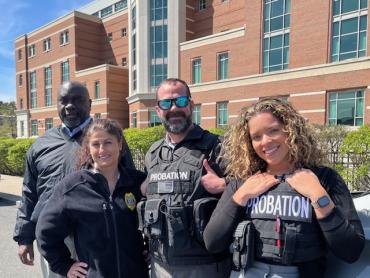
The AFT is a union of professionals from diverse backgrounds and a wide variety of professions, including members who work in the criminal justice and public safety fields. The AFT represents members ranging from parole and probation officers to corrections officers and staff in first-responder capacities. We also have members who keep our health facilities and school districts safe.
Research suggests that public safety work is among the most stressful occupations in the world. AFT members in this field work together to discuss issues of mutual concern and to offer solutions to common problems in our criminal justice system. Workers in the criminal justice profession understand the system and can be strong advocates to support their colleagues in addressing the challenges they face. We come together to talk about these challenges to strengthen our union and to ensure fair and equal treatment for all in the criminal justice system.
We recognize that a strong and vibrant democracy cannot function unless all people, regardless of the color of their skin or the work they do, can participate meaningfully in our society, with full rights and equal protections. Workers in public safety and criminal justice must work together to offer solutions to very difficult challenges facing our society. The AFT is committed to fostering an environment where all members’ voices are heard, and where workers put forward ideas that support our communities.
The criminal justice and public safety professionals in the AFT work together and support the AFT’s agenda to ensure justice for all, including civil and human rights, and to promote policies and legislation that encompass these principles and strengthen our democracy.
Public Safety and ICE
In recent months, ICE officers have killed multiple American citizens and migrants living in the U.S. These killings have brought the agency and its practices under increased scrutiny, including criticism for the lack of training that ICE officers receive. A recent report from the New York Times revealed that, despite receiving $750 million in additional funding for training, ICE has cut almost 40 percent of its training to “save time.” ICE agents should receive adequate training so they can do their jobs without harming people and disrupting communities.
Read this AFT Voices piece by Wayne Spence, AFT vice president and New York state parole officer, to learn more.
Related resources
AFT Resolutions
- In Support of Just, Respectful and Safe Public Safety Practices for All (2025)
- Against the Use of Excessive Force and Brutality by Law Enforcement (2021)
- Confronting Racism and in Support of Black Lives (2020)
- Reimagining Our Society and Rewriting the Rules to Enable Opportunity and Justice for All (2020)
Tackling Stress for Public Safety Staff
- Tackling Mental Health Challenges in the Public Safety Sector: Implementing and Evaluating Mental Health Programs
- Building Police Officer Psychological Capital to Mitigate Stress
- The Impact of Stress and Fatigue on Law Enforcement Officers and Steps to Control It
Public Safety Training Opportunities and Recruiting Challenges
- Community Oriented Policing Services (COPS) Training Portal
- Bureau of Labor Statistics, Probation Officers and Correctional Treatment Specialists
- The State of Recruitment: A Crisis for Law Enforcement