 Member Benefits
 How to Join
 En Espanol

This summer’s 250th anniversary of the Declaration of Independence is a monumental milestone. It provides a unique opportunity not only to celebrate the achievements and innovations of Americans over the centuries but also to reflect on the unfinished work of our democracy. Teaching students about the forces and tensions that shaped the nation’s creation—and highlighting the voices and experiences of those who have historically been excluded from this narrative—can help students better understand and think critically about the founding ideals that still guide and challenge us today.
Share My Lesson’s new curated collection, “America at 250: From Revolution to Republic,” includes nearly 100 resources to help educators and students consider the country’s origin story; the creation of its founding documents, especially the Declaration of Independence and the Constitution; and the many people who were central to the nation coming to be. Here, we highlight several of the most recent additions to the collection.
Exploring the Revolution
What was life like in the 13 British colonies? What issues, events, and leaders were key to the Revolution against Great Britain and the creation of an independent new nation? These questions are the focus of “From Colonies to Independence,” a nine-part history and geography unit intended for students in grades K–2, available through SML partner Core Knowledge. For grades 3–5, Core Knowledge also has “The Thirteen Colonies,” which considers each colony individually, including how and why they were established and the challenges that colonists faced.
Two resources for older students invite deeper discussion of the complexities and impacts of the Revolution. In the Project Look Sharp unit “Causes of the American Revolution,” students in grades 7–12 analyze historical evidence and media sources on the Revolution from multiple viewpoints—including those of the colonists, King George III, patriots, loyalists, enslaved people, and Native Americans—to learn how economic pressures and colonial resistance inflamed the conflict. And “Ken Burns’ The American Revolution Explores the Beginnings of the Nation’s Democracy,” from SML partner PBS News Hour Classroom, encourages students to examine how the war reshaped ideas about democracy and national identity, and why these ideas remain critical to democratic governance today.
Examining the Promise of the Founding
Teaching honestly about the nation’s founding means celebrating its animating democratic ideals while acknowledging the contradictions embedded in them—such as that “all men are created equal” with “unalienable rights”—as well as our continued struggles to implement them. Those contradictions and struggles are highlighted in two new resources well suited for older students.
“America at 250” is a new chapter of journalist Judy Woodruff’s long-running “America at a Crossroads” television series, provided by PBS News Hour Classroom for students in grades 7–12. In the series, Woodruff explores how the concept of being “American” has evolved since the nation’s founding and what it means today, particularly in light of the divisions and political rhetoric of recent years. Part 1 considers George Washington’s vision for the country he helped to create and how his evolution on slavery informs his legacy. Part 2 places the nation’s struggle for independence alongside Black Americans’ fight for equality in Boston schools. In Part 3, Woodruff interviews Pulitzer Prize–winning author and historian Joseph Ellis on who the Founding Fathers excluded in their vision of freedom and equality, and how that exclusion has informed US history. Part 4 brings this discussion to the present day, with the Trump administration’s attempts to erase challenging elements of the nation’s history in order to limit and reshape the history students are taught.
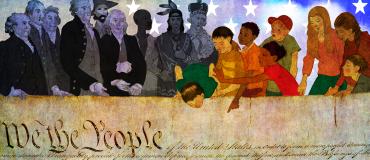
This resource may be especially powerful when paired with “We the People: Expanding the Teaching of the US Founding Inquiry,” by SML partner Facing History & Ourselves. Over the five lessons in this unit, students in grades 9–12 grapple with the gap between the founding ideals and the lived realities of injustice to consider a central question: “How do we reckon with a history full of complexities and contradictions?”
Engaging Students in Democracy
Teaching honestly about the founding of the United States is critical in any moment, but particularly so now that the health of our democracy is in serious decline. How can educators commemorate the 250th anniversary with students in a way that cultivates recognition of democracy as an ongoing project in which students are needed participants? Two educators who frequently contribute to SML give tips grounded in what works in their classrooms.
In “Teaching American History at 250: Hope, Honesty and the Work of Democracy,” Sari Beth Rosenberg, who teaches high school history, emphasizes the importance of creating classrooms that are safe spaces for students to think, question, and learn—where they are persuaded not to love or hate the country but to fully understand it and their agency to spur change. And in “Back to the Beginning: Early American Literature for Today’s Students,” Amber Chandler, who teaches middle school English language arts, shares how students can learn more about the values undergirding our democracy while also discovering a broader range of American literature than what is typically included in historical inquiry.
Of course, key to teaching a complete history of the United States and encouraging democratic engagement is highlighting the experiences of those whose voices have been traditionally marginalized or excluded. For dozens more resources focusing on the contributions and perspectives of Asian, Black, immigrant, Indigenous, Latine, and LGBTQIA+ communities, visit the new SML collection, “American History: Teaching Missing Narratives.”
Finally, tune in this July for SML’s Summer of Learning webinar series (July 21–30), which will include free, for-credit sessions that explore the 250th anniversary. For more details and to register, visit here.
Do you have resources you’d like to share? SML makes it easy! And if you have ideas or requests, reach out to content@sharemylesson.com.
–THE SHARE MY LESSON TEAM
[Illustrations by Sally Wern Comport]