 Member Benefits
 How to Join
 En Espanol
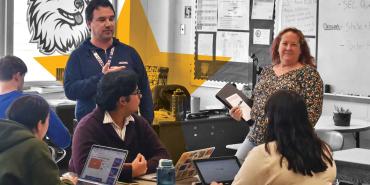
Long after the final bell has rung, I sit in my classroom at Wilbur L. Cross High School in New Haven, Connecticut, where over 75 percent of students are eligible for free or reduced-price meals.1 The quiet contrasts sharply with the mental noise of my daily work. As a social studies educator, I find myself constantly navigating the intersection of two powerful time periods: the enduring legacy of 1776 and the dynamic, often turbulent energy of 2026. Looking at the empty desks, I wonder how my students—who are growing up in one of the most diverse and economically challenged cities in the state—see themselves reflected in our nation’s founding documents. I question how a set of documents written more than two centuries ago remains important to a generation facing digital misinformation, historic polarization, and a shaky political landscape.
In my US government and American law courses, I strive to help my 10th- and 11th-grade students move past the trivia of history and recognize themselves as protagonists in the nation’s ongoing narrative—a shift we achieve through active historical inquiry.2 Day to day, I guide them in analyzing primary sources to develop critical disciplinary literacy3 and applying those historical lessons to the contemporary civic issues they encounter in digital spaces like TikTok and Instagram.4
We are standing on the threshold of a monumental era of celebration for our country. From 2026 to 2041, the United States will mark the semiquincentennial of the Declaration of Independence, the ratification of the US Constitution, and the adoption of the Bill of Rights. In Connecticut, we are also approaching the 400th anniversary of our colonial founding, which was among the very first experiments in self-government. These milestones, particularly in contrast to the democratic backsliding we are facing under President Trump,5 bring me back to Benjamin Franklin’s famous 1787 retort as he exited Independence Hall in Philadelphia. When asked by Elizabeth Willing Powel (one of George Washington’s confidantes) what kind of government the Constitutional Convention had produced, he didn’t offer a guarantee; he issued a challenge: “A republic, if you can keep it.”6
These commemorations provide opportunities to consider how the late 18th century informs our future, to deepen our understanding of the nation’s core principles, and to navigate the “tensions and ambiguities” of our shared journey.7 History is not merely a collection of remote facts, but a dynamic resource to grapple with our national identity and aspirations.8 Take the Preamble of the US Constitution, for example, which powerfully articulates our nation’s core purpose:
We the People of the United States, in Order to form a more perfect Union, establish Justice, insure domestic Tranquility, provide for the common defence, promote the general Welfare, and secure the Blessings of Liberty to ourselves and our Posterity, do ordain and establish this Constitution for the United States of America.
From the moment these words were written, even striving for this ideal has required overcoming significant institutional challenges, and today we benefit from—and continue—those efforts.
In my classroom, I have long prompted students to consider questions such as, “What was it like to live then?” or “What would you do?” These questions foster historical empathy, a critical cognitive process that allows students to understand the past on its own terms.9 However, in our new era of civic fragmentation, the separation between the late 1700s and current events is diminishing—and the urgency of these questions has reached a fever pitch. The pursuit of a “more perfect Union” continues through educators’ efforts to foster inclusivity and empathy, even as federal educational priorities shift toward a more nationalistic approach that considers honest history and equity programs “discriminatory.”10 All public school teachers, regardless of discipline, can serve as civic educators,11 and public schools can function as democratic institutions, striving to prepare future generations for an America that fully embodies the principle of “We the People.”
Lincoln’s Road Map: Truth Over Myth
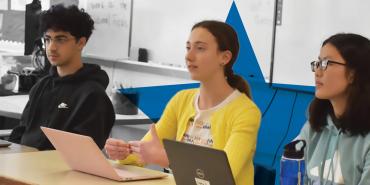
As educators deal with teaching in a polarized America, we can look to Abraham Lincoln for guidance. Lincoln understood that the myth of a perfect Union must eventually bow to the truth of a struggling one. In his 1838 Lyceum Address, a young Lincoln warned that the greatest threat to the American republic was not a foreign invader but internal decay—specifically, the breakdown of the rule of law and the rise of mob passions. He argued that the only way to sustain the republic was through a “political religion” of reverence for the law.12 In our era of political upheaval, I believe this is my primary task: teaching students that the foundation of liberty is respect for the rule of law.
Importantly, Lincoln also explained that “We the People” cannot be a selective term. In 1858, he gave a speech on the need to resolve the question of enslavement, famously stating that “a house divided against itself cannot stand.”13 Today, our house is still divided by many forms of inequity and bias; as a civic educator in an urban district, I see this division every day. Lincoln’s message still holds: If the promise of the Declaration that “all men are created equal” is not universal, the republic’s structure is unstable.
Perhaps naively, throughout most of my life I believed that our republic’s structure was stable. We hadn’t achieved our “more perfect Union,” but we seemed to be making progress (albeit too slowly). Then, on January 6, 2021, as the musical Hamilton puts it, “the world turned upside down.”14 Our nation’s Capitol was attacked by fellow Americans hoping to overturn a presidential election because of a lie. Worse, a lie propagated by the president. While experts in authoritarianism predicted that Trump would not give up the White House gracefully,15 to my students and me it was shocking—a deep stain on the republic. Suddenly, Franklin’s old warning was no longer a far-off anecdote. It was a reality we were living through.
I remember the overwhelming uncertainty of that day, wondering what I could possibly say to my civics students the next morning. We were still trapped in the digital boxes of COVID-era remote learning, and my instinct was to cancel our scheduled guest speaker, a federal magistrate judge, to process the breach of the US Capitol in private. But the magistrate insisted on logging on.
The next morning, I joined a digital classroom filled with nervous students. The magistrate didn’t sugarcoat things. He talked about the rule of law, explaining that the people students saw on the news might someday appear before him in court. Suddenly, the “mischiefs of faction” arising from “a number of citizens … united and actuated by some common impulse of passion … adverse to the rights of other citizens”16 that James Madison wrote about in Federalist No. 10 weren’t just vocabulary words—they were real, happening in our own time.
My worldview as an educator and American shifted that day. I realized that teaching the founding documents is about not only valuing tradition but also giving students the tools to understand and influence the world. These documents are blueprints for a house that’s always under renovation, striving to be less divided. It’s up to our students to decide whether the house will stand.
Pedagogy of Engagement and Action
For the past eight years, but with far more energy and commitment since January 6, 2021, I have transformed my classroom into a center for democratic engagement that cultivates active, responsible citizens. I rely on project-based learning (PBL) for much of this work because, nearly 20 years into my career, I’m confident that PBL represents the future of education. Done well, with effective implementation of high-quality materials and frequent student feedback, it allows students to develop the critical-thinking and collaborative skills necessary for modern life.17
We the People
My professional transformation began in 2017, when I joined the Center for Civic Education’s James Madison Legacy Project, which was funded by a US Department of Education Supporting Effective Educator Development grant.18 The grant’s primary emphasis was assisting teachers in under-resourced areas to close the “civic empowerment gap.”19 This yearlong professional learning experience introduced me to the We the People: The Citizen and the Constitution curriculum.20 Unlike typical professional development, the curriculum was created by real classroom teachers and constitutional scholars, and it made a real difference in my teaching.
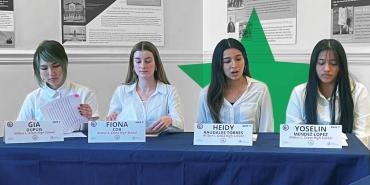
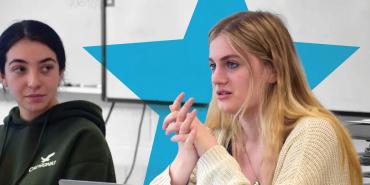
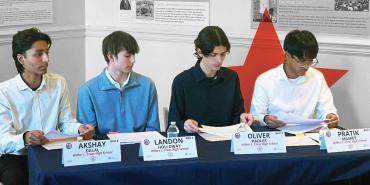
We the People engages students in doing history. The culminating activity that my students become immersed in is a simulated congressional hearing.21 It’s a dynamic experiment in classroom democracy that extends to regional, state, and national competitions. I organize six teams of students, typically three to five students each, who become constitutional experts on a specific unit of study. Each year, the Center for Civic Education releases unit questions that require students to dissect everything from Enlightenment theory to modern-day Supreme Court precedents. This hearing process is a hallmark of civic discourse—the ability to engage in civil, evidence-based deliberation.
Think of this as a typical government hearing: Each team delivers a prepared opening statement and then defends its position against follow-up questions from a panel. This simulation hones essential skills, including research, collaboration, and the evaluation of constitutional principles in a real-world context.
To begin this experience, we hold a “Candy Congress” hearing. I provide students with candy, and they must conduct rapid research to develop a two-minute pitch on why their selection should be the “national candy.” A panel of guest judges, often administrators or fellow teachers, asks follow-up questions to test their reasoning.
This initial activity serves as a catalyst for deeper engagement, introducing students to the hearing format while allowing them to navigate the risks and opportunities of public speaking in a low-stakes environment. By the time they reach the state competition, they are far beyond trivia about history, having mastered crucial skills like active listening and empathetic collaboration as they developed deep knowledge of democratic principles.22
Watching my students transform from passive learners into budding constitutional scholars is the most rewarding part of my job. When they work together to craft their four-minute testimonies, they wrestle with the why behind our laws, dig for evidence, and challenge each other’s thinking—a process that builds their perspective-taking and collaborative problem-solving abilities. The atmosphere in the room is electric when they practice answering tough, unscripted questions from a panel of volunteer judges; that’s when I know they are truly engaged citizens.
When I took my class to the Connecticut state We the People competition for the first time in 2018, I had no idea what to expect. My students struggled with follow-up questions, public speaking, and confidence. Asked about how to solve gerrymandering, they were stumped. After the competition, I went back to my mentor teachers and figured out how to manage the system given the odds stacked against us. The next year, I flipped the classroom so students worked independently in their teams. They worked with a law firm that helped them with follow-up questions. In the years following, we worked with Yale University graduate and law students to practice writing, reading essays, and answering follow-up questions.
Operating within an urban district like New Haven introduces unique challenges. For example, unlike schools with selective tryouts, coaching by high-power law firms, and booster clubs, I work with the students assigned to my roster, striving to secure their buy-in for a program that demands intense public speaking and critical thinking. And at the state competitions—which we’ve participated in every year since 2018—I frequently perceive bias in which affluent high schools are assigned the more spacious rooms and in how judges react to students’ clothing. Although the official judging rubric states that dress is not a scoring criterion, my students—many of whom cannot afford formal suits or professional attire—often face judges who seem to subconsciously correlate formal dress with academic depth. I explicitly prepare my students to overcome the stereotype that urban students lack the refinement of their suburban counterparts. And although we still don’t have a booster club, I have leaned into the New Haven community to build a grassroots support system. By utilizing my mentor network, engaging with the local federal court, and collaborating with college professors, college students, and local law firms, I have provided my students with the tools and resources to dismantle these stereotypes. We have turned challenges into opportunities for resilience, proving that brilliance is not defined by a zip code or a suit.
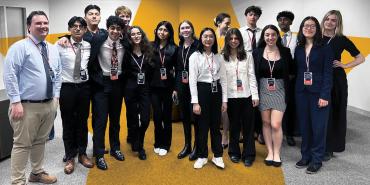
In 2023, we earned the honor of representing Connecticut at the We the People National Finals as the John Lewis class.23 This prestigious award is granted annually to a Title I school, accompanied by a $10,000 scholarship to facilitate travel to Washington, DC.24 Competing against teams from across the country, carrying the weight of New Haven and the legacy of Representative Lewis, my students encountered fair, rigorous judges who recognized them as brilliant, capable scholars. Placing 35th in the nation—and outperforming state champions and wild card entrants from 13 other states—they proved definitively that academic excellence is not confined by wealth. Even more importantly, my students demonstrated that when given the proper tools, they are the very people who will preserve the republic.
Project Citizen
Building on my experience with We the People, in 2021 I began teaching the Center for Civic Education’s other flagship program, Project Citizen. While We the People asks students to master the historical and aspirational why of our government, Project Citizen demands they tackle the practical how of public policy.25 It is one thing to debate the 14th Amendment in a mock hearing; it is quite another to walk into a real city council meeting and argue for a specific change in municipal policy.
My classroom is now a laboratory for this process within my social studies classes. My students follow a rigorous multistep journey: identifying community problems, researching existing policies, developing their own public policy proposals, and creating a concrete action plan to influence government officials. This framework immerses students in action civics, which research shows significantly increases their agency and long-term civic participation.26
The Project Citizen process requires students to identify a real community problem and advocate for a practical public policy solution. We spend significant time reflecting on community problems and brainstorming solutions, which integrates with our work on informed engagement. My students consider the multifaceted impacts of various policies, forcing them to develop empathy—a competency they often discover is more challenging to build than public policy knowledge. By grappling with the diverse needs of their New Haven neighbors, they realize that public policy is not just about laws and regulations, but also about the people. Using structured reflection, my students also evaluate how they are developing self-management skills, such as goal setting and perseverance, which are necessary for the grind of policy research and advocacy.27
The impact on our school has been remarkable. I have observed students applying the civic problem-solving and innovation skills acquired in my classroom to effect meaningful change. For example,
- students persuaded school administrators to create at least two wellness blocks per month during the school day to address mental health;
- student athletes successfully lobbied city government committees to build a new multipurpose turf field; and
- students testified before the state legislature in support of increased educational funding, which strengthened their advocacy skills.
Integrated Civic Competencies
Over the past school year, I have been deeply involved in implementing the Project Citizen: Integrated Civic Competencies (ICC) pilot program.28 This grant project, funded by the US Department of Education’s Education Innovation and Research program, is groundbreaking because it intentionally weaves social-emotional learning (SEL) into the framework of civic education. In our nation’s polarized climate, the ICC pilot focuses on teaching students civic SEL—the ability to engage in civil discourse, practice active and empathetic listening, and collaborate with classmates who hold different viewpoints.29 Unlike We the People and Project Citizen, which provide major curricular components for specific courses, these civic SEL competencies can be woven into any course.
One of the most profound impacts of this approach is the inclusivity it fosters. In my American law classes, where we routinely engage in Project Citizen, honors students work alongside life skills students to solve real-world problems. Emphasizing civic SEL has enhanced this collaboration as students with diverse backgrounds, experiences, and skills identify community problems, assess the trade-offs of alternative policies, and co-create action plans. For example, some students are developing a policy to address safety concerns as students walk to school, while others are working on a schoolwide kindness campaign. This process fosters genuine empathy and inclusive social skills while demonstrating the value of diverse teams for producing robust policy solutions.30
To ground their research in reality, we bridge the classroom-community divide by hosting guest speakers, from local activists to elected officials. Through this interaction, students practice active, empathetic listening and civil discourse with adults in positions of authority. They learn that informed engagement is not merely about having a loud voice, but about having a well-researched and respectful one that can hold its own in the public square.
In addition to enriching their public policy development, the ICC pilot has enabled my students to develop essential media literacy skills. Self-awareness, particularly in relation to civic identity and belonging, is a critical competency in this context. I encourage students to reflect on how information from various media sources aligns with or challenges their lived experiences and research—and to be on the lookout for misinformation.31 This process is integral to responsible decision-making, as students apply media literacy concepts to evaluate and refine their own reasoning.32
Students are learning to critically assess news sources as part of their civic problem-solving and innovation skills. By examining how media shapes their civic decisions, they transition from passive consumers to critical participants, capable of defending policy proposals with well-researched, contextually grounded evidence.33 As an educator, it’s thrilling to see my students shift from individual opinions toward collective, research-informed policy recommendations that can withstand scrutiny.34 It’s yet another way they are prepared to preserve the republic.
These Programs Work—But They Are in Jeopardy
Recent independent research from Georgetown University’s Civic Education Research Lab confirms that We the People and Project Citizen enhance learning and engagement. Students who participate in these programs demonstrate higher civic knowledge, stronger skills in civil discourse, and a greater likelihood of civic participation as adults.35
Despite overwhelming evidence of the programs’ efficacy, federal funding cuts have placed the future of these initiatives at risk. In June 2025, the Trump administration canceled specific US Department of Education (ED) grants for the Center for Civic Education programs, such as Civics that Empowers All Students and Project Community: Media Literacy and Public Policy. These grants had historically been a vital source of support for professional learning opportunities for teachers in high-needs urban and rural districts36—the very educators responsible for closing the civic empowerment gap.37 This move targeted the grants that sustained the Center for Civic Education’s ability to provide mentorship and resources to educators in urban centers like New Haven.
The loss of ED’s grant funding has dramatically reduced access to teacher training and new PBL opportunities for students in underserved communities, all but ensuring that only students in wealthy, well-resourced districts will receive a high-quality civics education.38 Indeed, research from early 2026 suggests that these cuts have already widened the civic empowerment gap, as schools in wealthier districts can continue to rely on private booster clubs and local endowments, while urban programs that depend on federal equity-based grants may be forced to scale back.39
The cancellation of these grants represents more than a budgetary shift; it is a direct challenge to the “We the People” ideal of universal civic preparedness and participation. It further divides the house, to use Lincoln’s metaphor, because “We the People” applies only to those who can afford it. If we truly want to keep the republic, we must treat civic education as the essential infrastructure of our nation—just as vital as our bridges and our power grids.
Our Civic Recession and the Future Direction
Tragically, these cuts come at a time when civic knowledge is critically low. Data from the National Assessment of Educational Progress are staggering. In 2022, the most recent assessment, only 22 percent of students performed at or above the “proficient” level—and 31 percent scored “below basic.”40 This means nearly 80 percent of our young people are entering adulthood without a deep understanding of how their government operates.
One of the most dangerous misconceptions that my students often hold is that local elections don’t matter. While the president dominates the headlines, it is the city council, school board, and state legislature that decide the quality of the roads, the funding for schools, and the laws governing safety.41 Yet, the data show a massive participation gap. While presidential elections often see turnouts around 65 percent,42 municipal elections frequently see turnouts as low as 15 to 27 percent.43 When we neglect local ballots, we give up our voice to a tiny, nonrepresentative fraction of the population.
This is why developing students’ civic knowledge ought to be a requirement, not an elective. Currently, civic education in the United States is a patchwork of inconsistency. As of 2025, only 36 states and the District of Columbia required at least one civics or government course to graduate high school,44 and as of 2024, a mere seven states required a full year of study.45 Even more concerning is the lack of hands-on civics; as of 2018, 11 states included a civic action project or experiential learning component like Project Citizen in their standards46 (but in 2025, 39 states and the District of Columbia at least incentivized service learning by offering credit47). Without a PBL requirement, civics is a dry affair of memorizing names and laws rather than a living exercise of power. When students are required to complete a project, they gain agency. They realize they don’t have to wait until they are 18 to have a seat at the table.
In a time defined by rapid information exchange and challenges, the ability to collaborate, think critically, and solve problems is the new “literacy.” When students take part in programs like Project Citizen and We the People, they move beyond passive absorption of facts into the active roles of constitutional scholars and policy analysts. And when they learn civic SEL, they are prepared to work with people who have very different perspectives, beliefs, and values. The types of experiential learning offered by the Center for Civic Education are the bridge between the classroom and the community, ensuring that the next generation knows about the government and how to work it by coming together for the greater good.
Ultimately, integrating Project Citizen and We the People, along with civic SEL, into high school courses for all students would create a resilient republic. Given the endless struggles over allocation of resources, when students successfully advocate for a wellness block or a new turf field, they are managing the “mischiefs of faction” just as Madison envisioned. They are learning to deal with the tension between the individual and the state. By making civic education a rigorous, project-based requirement, we ensure that the “We” in “We the People” remains inclusive, informed, and capable of self-governance. This is how we answer Franklin’s challenge: not with a textbook, but with a generation of practiced, virtuous citizens ready to lead.
As we mark the 250th anniversary of the Declaration of Independence, Madison’s Federalist No. 51 remains the structural blueprint for our survival. Madison famously cautioned that “if men were angels, no government would be necessary.”48 By teaching my students that “ambition must be made to counteract ambition,”49 I am framing their roles as citizens—not as spectators, but as the necessary friction in the constitutional machine. They are the ultimate check on power, the force that stops any one faction from silencing “We the People.”
The story of civic education in America is still being written, and every day in classrooms like mine, students are wielding their pens and honing their voices. The future of our democratic society relies on how well prepared they are to participate as informed, thoughtful citizens. Programs like We the People and Project Citizen offer young people more than just knowledge; they nurture the habits, skills, and confidence essential to a thriving democracy.50 This is particularly vital in the face of our modern challenges.
If we are to keep the republic, we must invest in the next generation’s civic learning. This means ensuring that all students, regardless of their background or zip code, are empowered to shape our nation’s unfinished story. With or without federal support, the movement for rigorous, inclusive, hands-on civic education must continue. We do not just teach history; we prepare the people who will make it.
Brian S. Grindrod is a social studies teacher and Advanced Placement coordinator at Wilbur L. Cross High School in New Haven, Connecticut. He serves as a mentor for the Center for Civic Education’s We the People and Project Citizen programs. Additionally, he is one of his school’s social-emotional learning ambassadors and serves as the Student Council advisor. In 2026, the Connecticut Council for the Social Studies honored him with the Award for Excellence in Social Studies Education, Grades 9–12. Grindrod used Gemini to assist with brainstorming and revising his original draft; he critically reviewed, edited, and verified all AI-generated suggestions to ensure they align with his professional expertise and pedagogical vision.
Endnotes
1. EdSight, “Wilbur Cross High School,” Connecticut Report Cards, 2025–26, go.aft.org/vuy.
2. K. Barton and L. Levstik, Teaching History for the Common Good (Routledge, 2004); and S. Wineburg, Why Learn History (When It’s Already on Your Phone) (University of Chicago Press, 2018).
3. Library of Congress, “Primary Sources and Standards,” loc.gov/programs/teachers/getting-started-with-primary-sources/primary-sources-and-standards.
4. J. Kahne et al., Civic Reasoning and Discourse Across the Curriculum: Digital Citizenship Education (National Academy of Education and National Association for Media Literacy Education, 2024), naeducation.org/wp-content/uploads/2025/06/NAE-CivicReasoningDiscourse-DigitalCitizenshipEducation.pdf.
5. R. Ben-Ghiat, “The Trump Administration Is Trying to Wreck Our Democracy,” American Educator 49, no. 3 (Fall 2025): 12–17.
6. As recounted in J. Miller, “‘A Republic If You Can Keep it’: Elizabeth Willing Powel, Benjamin Franklin, and the James McHenry Journal,” Blogs: Manuscripts at the Library of Congress, January 6, 2022, blogs.loc.gov/manuscripts/2022/01/a-republic-if-you-can-keep-it.
7. American Association for State and Local History, Making History at 250: The Field Guide for the Semiquincentennial (2021), download.aaslh.org/Making+History+at+250+Field+Guide.pdf.
8. P. Stearns, “Why Study History?,” American Historical Association, January 1, 1998, historians.org/resource/why-study-history-1998.
9. O. Davis, E. Yeager, and S. Foster, eds., Historical Empathy and Perspective Taking in the Social Studies (Rowman & Littlefield, 2001); and Wineburg, Why Learn History.
10. N. Marcus, “Trump’s War on Diversity, Equity, and Inclusion,” CWSL Scholarly Commons, California Western School of Law, 2026, scholarlycommons.law.cwsl.edu/cgi/viewcontent.cgi?article=1530&context=fs.
11. L. Hamilton, “Teachers in All Subjects Must Help Prepare the Next Generation of Voters,” The 74, November 1, 2024, the74million.org/article/teachers-in-all-subjects-must-help-prepare-the-next-generation-of-voters; and S. Mitter, “‘Every Teacher Is a Civics Teacher,’” April 11, 2018, tc.columbia.edu/articles/2018/april/at-academic-festival-eric-liu-calls-on-educators-to-lead-a-democratic-renewal.
12. A. Lincoln, “Speech to the Young Men’s Lyceum of Springfield (1838),” National Constitution Center, constitutioncenter.org/the-constitution/historic-document-library/detail/abraham-lincoln-speech-to-the-young-mens-lyceum-of-springfield-1838.
13. A. Lincoln, “House Divided Speech: Springfield, Illinois: June 16, 1858,” Abraham Lincoln Online, abrahamlincolnonline.org/lincoln/speeches/house.htm.
14. L.-M. Miranda, “Hamilton: An American Musical,” Atlantic Records, 2015; and Wikipedia, “Yorktown (The World Turned Upside Down),” Wikimedia Foundation, April 17, 2026, en.wikipedia.org/wiki/Yorktown_(The_World_Turned_Upside_Down).
15. A. Goodman, “Fascism Expert Says Trump’s Cult of Personality Is Growing,” AlterNet, January 9, 2022, alternet.org/2022/01/trump-cult-of-personality; and J. Goldfeder and L. Mitchell, “They Predicted a Trump Coup Attempt. Hear What They Say Now,” CNN, August 6, 2021, cnn.com/videos/politics/2021/08/06/assault-on-democracy-election-experts-predicted-trump-coup-goldfeder-mitchell-newday-sot-vpx.cnn.
16. J. Madison, “Federalist No. 10: The Same Subject Continued: The Union as a Safeguard Against Domestic Faction and Insurrection: From the New York Packet: Friday, November 23, 1787,” Library of Congress, guides.loc.gov/federalist-papers/text-1-10#s-lg-box-wrapper-25493273.
17. L. Zhang and Y. Ma, “A Study of the Impact of Project-Based Learning on Student Learning Effects: A Meta-Analysis Study,” Frontiers in Psychology 14 (July 2023): 1202728; and Y. Terada, “New Research Makes a Powerful Case for PBL,” Edutopia, February 21, 2021, edutopia.org/article/new-research-makes-powerful-case-pbl.
18. Civic Education Research Lab, “James Madison Legacy Project,” Georgetown University, cerl.georgetown.edu/cerl-research/james-madison-legacy-project.
19. D. Owen, Project Citizen Research Program: 2024 Report (Civic Education Research Lab, Georgetown University, March 2024), www.researchgate.net/publication/378867385_PCRP_Final_Report.
20. Center for Civic Education, “Research and Evaluation – We the People,” civiced.org/research/wtp-research; and Center for Civic Education, Find Your Place in We the People: 2024 Annual Report (2024), civiced.org/pdfs/annualreports/FY24_AnnualReport_CenterForCivicEducation.pdf.
21. Center for Civic Education, “We the People: Simulated Congressional Hearings,” civiced.org/we-the-people/hearings.
22. Center for Civic Education, “Research and Evaluation.”
23. Center for Civic Education, “Teams,” 2023, civiced.org/national-finals-2023-teams.
24. Center for Civic Education, “Research and Evaluation”; and Center for Civic Education, Find Your Place.
25. Center for Civic Education, “Project Citizen: What Is Project Citizen?,” civiced.org/program-project-citizen; and Owen, Project Citizen Research Program.
26. P. McSweeney, “Media Literacy That Moves the Needle: Findings from Project Community,” Civic Education Research Lab, February 26, 2026, civiceducationresearchlab.substack.com/p/media-literacy-that-moves-the-needle; D. Owen, “The Challenge of Misinformation in the Civics Classroom,” Journal of Applied Communication Research 54, no. 1 (2026): 137–43; D. Owen and P. McSweeney, James Madison Legacy Project Expansion Program Final Report (Civic Education Research Lab, Georgetown University, 2026), civiced.org/pdfs/JMLPE_ResearchReport_Final_2026.pdf; and K. Siegel-Stechler, N. Price, and A. Medina, “Youth Who Develop Their Voice in High School Are More Likely to Vote,” Center for Information & Research on Civic Learning and Engagement, Tisch College, March 12, 2024, circle.tufts.edu/latest-research/youth-who-develop-their-voice-high-school-are-more-likely-vote.
27. CASEL, “SEL and Civic Learning,” casel.org/fundamentals-of-sel/how-does-sel-support-your-priorities/sel-and-civic-learning.
28. Center for Civic Education, “Project Citizen: Integrated Civic Competencies,” civiced.org/integrated-civic-competencies.
29. CASEL, “SEL and Civic Learning”; Center for Civic Education, “Project Citizen: Integrated Civic Competencies”; and Owen, Project Citizen Research Program.
30. McSweeney, “Media Literacy”; and Owen and McSweeney, James Madison Legacy.
31. Owen, “The Challenge of Misinformation.”
32. Digital Inquiry Group, “Civic Online Reasoning,” cor.inquirygroup.org; Wineburg, Why Learn History; and M. Caulfield and S. Wineburg, “Learning to Verify,” American Educator 49, no. 1 (Spring 2025): 44–45.
33. McSweeney, “Media Literacy”; Owen, “The Challenge of Misinformation”; and Center for Civic Education, “Project Community: Engaging All Students in Media Literacy and Public Policy,” civiced.org/project-community.
34. Owen, Project Citizen Research Program; and Owen and McSweeney, James Madison Legacy.
35. Owen and McSweeney, James Madison Legacy; and Owen, Project Citizen Research Program.
36. A. Ma, “Trump Slashed Teacher Training, Citing DEI. Educators Say the Grants Fought Staff Shortages,” Associated Press, March 6, 2025, apnews.com/article/trump-education-department-teacher-training-doge-34f1a56f7394ee3343412e6a96b635c7; and M. Lieberman, “Trump Slashed Billions for Education in 2025. See Our List of Affected Grants,” Education Week, January 27, 2026, edweek.org/policy-politics/trump-slashed-billions-for-education-in-2025-see-our-list-of-affected-grants/2026/01.
37. D. Savage, “Supreme Court OKs Trump’s Cuts to Teacher Training Grants in California,” Los Angeles Times, April 4, 2025, latimes.com/california/story/2025-04-04/supreme-court-oks-trumps-cutbacks-on-teacher-training-grants-in-california.
38. C. Jones, “Why Income and Tense Politics Are Limiting Access to Civics Classes in California,” Cal Matters, December 19, 2024, calmatters.org/education/k-12-education/2024/12/civics-education; and M. Levinson, “Benefits of Civic Education: Increased Equality and Narrowed Civic Empowerment Gap,” in Guardian of Democracy: The Civic Mission of Schools, ed. J. Gould (Leonore Annenberg Institute for Civics, Annenberg Public Policy Center, University of Pennsylvania, 2011), dash.harvard.edu/bitstreams/7312037c-d782-6bd4-e053-0100007fdf3b/download.
39. Owen and McSweeney, James Madison Legacy; and L. Tomasko et al., How Government Funding Disruptions Affected Nonprofits in Early 2025 (Urban Institute, October 2025), urban.org/sites/default/files/2025-10/How_Government_Funding_Disruptions_Affected_Nonprofits_in_Early_2025.pdf.
40. National Assessment of Educational Progress, “NAEP Report Card: 2022 NAEP Civics Assessment,” National Center for Education Statistics, US Department of Education, nationsreportcard.gov/highlights/civics/2022.
41. J. Schuetz, “Voting in Local Elections Impacts Life and Death: A Case Study in Washington, DC,” Brookings, October 31, 2018, brookings.edu/articles/voting-in-local-elections-impacts-life-and-death-a-case-study-in-washington-dc.
42. USA Facts, “How Many Americans Voted in 2024?,” June 18, 2025, usafacts.org/articles/how-many-americans-voted-in-2024.
43. M. Girardin, “Voter Turnout in Local Elections: Why It’s Low and How to Fix It,” GoodParty.org, March 8, 2025, goodparty.org/blog/article/voter-turnout-in-local-elections.
44. A. Benites, “2025 State Policy Scan Provides Updated Insight into Civic Learning Policies, State by State,” CivxNow, August 25, 2025, civxnow.org/2025-state-policy-scan.
45. S. Craiutu and J. Ngalande, “State Civics Requirements in 2024,” Hoover Institution Press, December 17, 2024, hoover.org/research/state-civics-requirements-2024.
46. R. Winthrop, “The Need for Civic Education in 21st-Century Schools,” Brookings, June 4, 2020, brookings.edu/articles/the-need-for-civic-education-in-21st-century-schools.
47. Benites, “2025 State Policy Scan.”
48. A. Hamilton or J. Madison, “Federalist No. 51: The Structure of the Government Must Furnish the Proper Checks and Balances Between the Different Departments: From the New York Packet: Friday, February 8, 1788,” Library of Congress, guides.loc.gov/federalist-papers/text-51-60#s-lg-box-wrapper-25493427.
49. Hamilton or Madison, “Federalist No. 51.”
50. Owen and McSweeney, James Madison Legacy.
[Photos courtesy of the author; illustrations by AFT staff]