 Member Benefits
 How to Join
 En Espanol

At this joyful yet perilous moment in America’s history, as we celebrate the 250th anniversary of our Declaration of Independence while fighting democratic backsliding,1 I find it comforting to visit the National Mall in Washington, DC, which draws its inspiration from the broad sweep of American history. At the western end of the Mall is the Lincoln Memorial. Lincoln gazes east on the Capitol, where the question of whether we will keep our republic looms. I take refuge in the south chamber, where the Gettysburg Address is inscribed, declaring “that government of the people by the people for the people shall not perish from the earth.” Lincoln understood that democracy is our guardian angel and our anvil against tyranny. He also understood that the poetry and promise of the American experiment in self-governance is ignited by the democratic imagination in our classrooms. According to his law partner, William Herndon, Lincoln believed “that universal education should go along with and accompany the universal ballot in America; that the very best, firmest, and most enduring basis of our republic was … the thorough and the universal education of the great American people; and that the intelligence of the mass of our people was the light and life of the republic.”2
I began my career as a social studies and history teacher in a rural Massachusetts public school. I have fond memories of classes about the Declaration of Independence, the American Revolution, and our struggles to live up to our founding ideals of liberty and justice. Those days seem far away now. Today, the very foundation of our republic, which once seemed so sturdy and reliable, feels unstable and fragile. In 2025, the Pew Research Center found that “just 17% of Americans now say they trust the government in Washington to do what is right.”3 In a 2025 survey of American political attitudes conducted by Johns Hopkins University and Public Agenda, 84 percent of respondents said “democracy is either in crisis or facing serious challenges.”4 We struggle in confusion, unsure of the future and unable to find safety or common sense in today’s political and social environment. Our democratic imaginations are adrift on a sea of doubt and distrust.

Inspiring Young People
I believe we need to move beyond civics and history lectures alone if we want to inspire young people about the beauty and necessity of democracy. We need curricula built on big ideas about the world we live in. Disconnected facts are not inspiring. Big ideas about the power of democracy to lift the human spirit and create a vibrant, just society cause imaginations to soar. The work of neuroscientist Mary Helen Immordino-Yang reveals that what she calls transcendent thinking has the power to transport us from here and now to the future and everywhere else.* When young people are offered opportunities to time travel in the company of big ideas, the experience “seems to literally build their brains.”5 Igniting the democratic imagination is fueled by connecting deeply and meaningfully with others. A democratic imagination is not a thing to possess; it is a gift we share with each other. It is an invitation to come together to create a society where everyone is somebody. It is not a fixed mental structure of mind; it is a fluid and energizing process of cognitive and emotional experimentation. The democratic imagination draws strength and purpose from a conviction that equality and justice are the pillars of a good society.
In the fall of 2025, the Harvard Kennedy School published the results of its most recent youth poll. The findings are deeply disturbing:
Young Americans are sending a clear message: the systems and institutions meant to support them no longer feel stable, fair, or responsive…. Their trust in democracy, the economy, and even each other is fraying—not because they are disengaged, but because they feel unheard and unprotected in a moment of profound uncertainty. Listening to them, fully and without precondition, is essential if we hope to rebuild that trust—one of the defining challenges of our time.6
Inspiring and enabling young people to embrace and celebrate democracy is a defining challenge we cannot ignore. If we fail to inspire our students today, democracy will fail tomorrow. As the former University of Pennsylvania president and ambassador Amy Gutmann noted, “Liberty, opportunity, and mutual respect are not self-evident or self-perpetuating. They must be carefully taught or else opposing values—authoritarianism, plutocracy, intolerance, bigotry, and hatred—will dominate our societies.”7
The history of the United States is not without its blemishes and shameful moments, but throughout the 250 years since the nation’s founding, generations of Americans have been inspired by the ideals and principles of democracy. We need to engage students in ways that touch their heads and their hearts. They need to feel that the story of America is their story—and therefore, the stories we share in our classrooms must embrace all who call this land home, whether their families have been here for thousands of years, were forced to come, or strove to arrive. They all deserve classrooms alive with the excitement of learning and inspired by the ideals of democracy.

Igniting Democratic Imaginations
In the last several years, I have visited dozens of high-performing schools serving low-income communities across the South and Northeast. I have learned a great deal from the educators in these schools about how students’ democratic imaginations can be ignited. Nearly all of these schools are underfunded. Very often, food is in short supply in students’ homes. New curriculum materials are rare. Technology is often outdated. What is not in short supply is teachers who truly believe in the American dream and are fiercely committed to the ideals upon which American democracy is founded. Their commitment and belief are enacted in their classrooms and throughout their schools, where student voice is celebrated. Languages other than English can be heard in the halls and classrooms. History and social studies courses are brought to life through biographies, stories, debates, plays, and civic-minded projects. Students enroll in internships with community organizations, and new programs are developed to help students get ready for success after graduation. Families are invited to join in learning. Mental and physical health services are provided. In these schools, each child is recognized as somebody, and democracy is a way of life.
A recent survey by the Center for Information & Research on Civic Learning and Engagement (CIRCLE) revealed that 63 percent of young people had a “passive appreciation” of democracy, 31 percent expressed “dismissive detachment,” and 7 percent reported “hostile dissatisfaction.”8 Rather than “preach the value of democracy,” CIRCLE recommends four levers of change:9
- Engage young people in leading changes to our democratic institutions so they work for youth and are more responsive to their needs.
- Invest in access to opportunities for civic learning and engagement and in support for youth to acquire the skills and values necessary for democratic participation….
- Focus on efforts to address differences by socioeconomic status and disparities in support for civic development.
- Create opportunities for collaboration and collective action that leverage young people’s strengths, like the belief in democracy of youth who passively appreciate it and the urgency for action of youth who are dissatisfied with it.
Perhaps a fifth lever of change is awakening students’ democratic imaginations.
A Passion for Possibility
The educational philosopher Maxine Greene once said, “Imagination … is the capacity to break with the ordinary, the given, the taken-for-granted and open doors to possibility. One way of describing it is as a ‘passion for possibility.’”10 One of the schools I visited in North Carolina used trailers for classrooms, not an ideal setting for inspiring students. But to the young middle school history teacher who was leading a spirited discussion of the American Revolution, it was a perfect setting to learn about democracy. The classroom was decorated with posters of George Washington, Abraham Lincoln, Harriet Tubman, and Martin Luther King Jr. Books were scattered about everywhere. The teacher was on fire with the story of our country’s founding. He walked back and forth, asking questions and listening to his students as they discovered together the fascinating story of how the American Revolution turned the world upside down.
The teacher read the preamble of the Declaration of Independence. Many of his students work in wheat and soybean fields before and after school. Many have limited English skills. Many of their families come from Central America. Many are hungry every night—but he captured their imaginations. He broke them into small groups to answer the question, “What does ‘all men are created equal’ mean?” The students began to talk with each other. The excitement level in the classroom shot up with students asking questions about what equal means and why people should be treated with respect. These students’ democratic imaginations came to life in a freewheeling, collective, and joyful conversation with history, society, and each other.
Some Guiding Principles
In my experience, the art of igniting democratic imaginations rests on certain commitments and approaches to learning.
- Foster positive democratic relationships. Top-down classrooms with rigid rules breed conformity and social anxiety. The most lively and informative history and social studies classes I have seen are those where students connect with each other and with the teacher. As one teacher at a school I visited said, “relationships are everything.”
- Challenge students with big ideas. Big, powerful ideas, such as “all men are created equal” and “Governments are instituted among Men, deriving their just powers from the consent of the governed,”11 should be our educational North Stars. Grappling with big ideas is how students develop their understandings of the world.12
- Engage students in deep, sustained reading as the cornerstone of learning. There is growing evidence that students’ attention spans are getting shorter and shorter (though they can still be developed).13 Students are reading less and less, and books and original documents are being replaced far too often by AI-generated texts and videos. The democratic imagination thrives on rigor and truth. Especially as we celebrate the 250th anniversary of the Declaration of Independence, students should be immersed in reading and discussing it, along with the Constitution and the Bill of Rights.
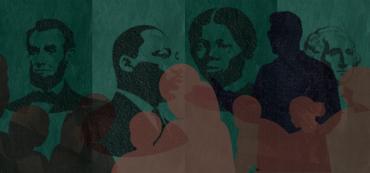
- Celebrate democratic heroes. Today, the federal government is trying to erase much of American history. Abraham Lincoln reportedly said, “history is not history unless it is the truth.”14 Students need to know we have a long and glorious past of people who have fought for democracy and for the idea of equality against great odds. When real history speaks, we listen and learn.
- Break down the division between school and society. Developing a democratic imagination happens by interacting with the world. Through intentionally structured projects, educators can support students in joining with other students around the world to propose solutions to the world’s most urgent challenges—like the shortage of drinkable water15 and lack of equitable access to vaccines as global warming intensifies droughts and increases disease transmission.16
- Cultivate community as the home of the democratic imagination. Schools are communities, and through them we should celebrate the power of us. Assemblies with local and national speakers followed by vigorous student-led discussions are one way to weave a shared culture of excitement, friendship, and purpose. Another is community-service projects like get-out-the-vote campaigns and soliciting donations to food banks.
- Practice peaceful conflict resolution. Anger has become a way of life for too many of us. Democratic processes are meant to resolve differences through negotiation, compromise, and tolerance. If students do not develop these dispositions through debates, discussions, reading, and writing, they are likely to default to amplifying anger rather than mitigating it.
Becoming a democratic citizen—a person who values liberty, opportunity, and mutual respect, as Gutmann describes it—is a lifelong process. Educators are the stewards of the future; schools are the home of democracy.
Our Robust Republic: The View from the Classroom
In 2024, the research organization Economist Intelligence Unit found that “only 45% of the world’s population lives in a democracy, 39% under authoritarian rule, and 15% in ‘hybrid regimes’ that combine electoral democracy with authoritarian tendencies.”17 Today, the United States is becoming increasingly fragmented and is drifting toward a dystopian authoritarianism.18
This trend toward authoritarianism is global. According to Freedom House, “eighty percent of the world’s people live in countries or territories that are rated Not Free or only Partly Free.”19 If this trend advances unchecked, there is a real risk that democracy will wither and pass into history.
Our children are caught in the crossfire of our political wars. If we can turn our classrooms into communities of conscience and ignite students’ democratic imaginations, we can be on the road to robust republics that welcome all.
Solidarity is our bulwark of hope, but time is short. The economist Nouriel Roubini warns us the future will be shaped by how we meet the enormous challenges awaiting us, including massive debt, climate change, technological disruptions like artificial intelligence, aging populations, and geopolitical clashes among great powers.20 I would add to this list, in big and bold letters, the preservation of public education and democracy—which for me are represented in the enduring symbol of the yellow school bus. Because the foundation of American democracy is public education, attacks on public education are attacks on democracy. We all need to get on the yellow school bus. It is the only way we can arrive together at our destination: a robust republic that will carry us into a democratic future.
Peter W. Cookson, Jr., is a senior research fellow at the Learning Policy Institute and teaches at the McCourt School of Public Policy at Georgetown University. A former elementary and middle school teacher, he is the author of 20 books, most recently School Communities of Strength: Strategies for Educating Children Living in Deep Poverty.
*To learn more about transcendent thinking, see “When Students Think Beyond the Moment” in the Spring 2026 issue of American Educator. (return to article)
Endnotes
1. R. Ben-Ghiat, “The Trump Administration Is Trying to Wreck Our Democracy,” American Educator 49, no. 3 (Fall 2025): 12–17, aft.org/ae/fall2025/ben-ghiat; and R. Weingarten, “Why Do Fascists Fear Teachers?: Because We Teach Critical Thinking,” American Educator 49, no. 3 (Fall 2025): 6–11, aft.org/ae/fall2025/weingarten_book.
2. Z. Klitzman, “A Universal Right for All—Lincoln and Education,” President Lincoln’s Cottage, September 4, 2019, lincolncottage.org/a-universal-right-for-all-lincoln-and-education.
3. Pew Research Center, “Public Trust in Government: 1958–2025,” December 4, 2025, pewresearch.org/politics/2025/12/04/public-trust-in-government-1958-2025.
4. A. Lentini, “New Research Finds Americans Deeply Concerned About U.S. Democracy,” Hub (blog), Johns Hopkins University, November 23, 2025, hub.jhu.edu/2025/11/23/agora-survey-democracy-concerns.
5. M. H. Immordino-Yang, “Transcendent Thinking May Boost Teen Brains,” Scientific American, January 21, 2025, scientificamerican.com/article/transcendent-thinking-boosts-teen-brains-in-ways-that-enhance-life.
6. Harvard Kennedy School Institute of Politics, “Harvard Youth Poll,” 51st Edition, Fall 2025, iop.harvard.edu/youth-poll/51st-edition-fall-2025.
7. M. Sardoc, “Democratic Education at 30: An Interview with Dr. Amy Gutmann,” Theory and Research in Education 16, no. 2 (2018): 244–52.
8. Center for Information & Research on Civic Learning and Engagement (CIRCLE) and Protect Democracy, Report: How Does Gen Z Really Feel About Democracy? (Tufts University, April 7, 2025), circle.tufts.edu/report-genz-attitudes-democracy.
9. CIRCLE and Protect Democracy, Report: How Does Gen Z Really Feel?
10. M. Greene, “Imagination and the Healing Arts,” Maxine Green Institute, 2007, maxinegreene.org/uploads/library/imagination_ha.pdf.
11. National Archives, “America’s Founding Documents; Declaration of Independence: A Transcription,” archives.gov/founding-docs/declaration-transcript.
12. Immordino-Yang, “Transcendent Thinking”; and M. H. Immordino-Yang, C. Kundrak, and K. Street, “When Students Think Beyond the Moment: Enhancing Adolescents’ Development by Engaging Their Emotions,” American Educator 50, no. 1 (Spring 2026): 17–21, aft.org/ae/spring2026/immordino-yang_kundrak_street.
13. D. Willingham, “Ask the Cognitive Scientist: Do Today’s Kids Have Reduced Attention Spans?,” American Educator 50, no. 1 (Spring 2026): 12–16, aft.org/ae/spring2026/willingham.
14. D. Wilson, “Remarks on Being Awarded the Lincoln Prize,” American Historical Association, November 1, 1999, historians.org/perspectives-article/remarks-on-being-awarded-the-lincoln-prize-november-1999.
15. United Nations International Children’s Emergency Fund, “Water Scarcity,” unicef.org/wash/water-scarcity.
16. International Vaccine Access Center, A Warming World Means Vaccination Is More Important Than Ever (Johns Hopkins University, December 2023), publichealth.jhu.edu/ivac/a-warming-world-means-vaccination-is-more-important-than-ever.
17. Economist Intelligence Unit, Democracy Index 2024 (The Economist, 2024), eiu.com/n/campaigns/democracy-index-2024.
18. Weingarten, “Why Do Fascists Fear Teachers?”
19. Freedom House, “Countering Authoritarianism,” freedomhouse.org/issues/countering-authoritarianism.
20. N. Roubini, MegaThreats: Ten Dangerous Trends That Imperil Our Future, and How to Survive Them (Little, Brown, 2022).
[Illustrations By Erin K. Robinson]