 Member Benefits
 How to Join
 En Espanol

A recent controversy in the reading world is whether findings from reading research, sometimes referred to contemporaneously as the “science of reading,” apply to students who are not proficient in the language they are learning to read. In the United States, these students are known as English Learners (ELs), emergent bilinguals, or multilingual learners. These terms all have slightly different meanings, but they are generally used interchangeably. We’ll use ELs for simplicity. However we refer to them, critics claim that not only does the “science of reading” not apply to ELs, but it is also detrimental to their literacy development.1
The controversy is unnecessary, even harmful, as it obscures important information and understandings that would help educators better serve their ELs. Research from the United States and around the world demonstrates that what we know about how children acquire literacy when they know the language they are learning to read is just as relevant for students who are learning the language as they are learning to read and write it.2
There is an important qualification, however. Although learning to read, according to neuroscientist Kenneth Pugh, is based on “cognitive universals”3 that do not vary depending on whether one is bilingual or monolingual, there is a significant difference: If you’re learning to read in a language you don’t yet know, you need to learn the language as you are learning to read it. Gaining facility with written language (literacy) requires understanding and being able to produce the language.
Reading instruction for ELs must therefore include English language instruction that directly supports the acquisition of English literacy skills and, more generally, advances English language development to increasingly advanced levels of proficiency.* This is necessarily more complex than learning to read in a language one already knows.
Learning to read in a language one already knows is very well described by the “Reading Rope” developed by literacy researcher Hollis Scarborough 25 years ago.5 This insightful metaphor (which is available for free here) is an elaboration of the “Simple View of Reading,”6 which proposed that reading comprehension (more generally, reading success, skill, or ability) is the result of two distinct sets of skills: “decoding” and “oral language comprehension.”
The Reading Rope goes several steps further than the Simple View by distilling a large body of research into a comprehensible representation of what individuals must learn and be able to do to become successful readers. Like the Simple View, the Reading Rope conceptualizes two principal sets of skills: “word recognition” and “language comprehension.” Note that “word recognition” is a more inclusive concept than “decoding” and overlaps with language comprehension, since recognizing a word requires knowing something about it besides how it’s pronounced (which is all that decoding provides). If you know the word, or even that it is a word, you can recognize it once you’ve decoded it. If you don’t know anything about the word, decoding only provides you with the pronunciation according to orthographic rules or patterns.
The Reading Rope has become one of the defining images in contemporary discussions of reading education. We wanted to find a visual way to represent the process of ELs learning to read English that is as compelling and helpful as Scarborough’s Reading Rope is for students who already know the language in which they are learning to read.
Our earliest attempt to create such a visual was relatively straightforward: We layered yellow “threads” within the rope strands to represent English language supports, or scaffolds, for literacy instruction.7 A simple example of this support is to teach ELs the meanings of the words that are used to teach phonemic awareness or phonics. In this way, lessons would simultaneously build English oral language skills (vocabulary) and English literacy skills (phonemic awareness or phonics). But we soon learned that the Reading Rope’s copyright owner (the publisher Guilford) would not agree to adaptations, so we had to develop a new approach.
We therefore decided to reconceptualize the metaphor as distinct lanes converging into a road, retaining some components of the Reading Rope while modifying and adding others, all of which educators should recognize. We named the graphic the “Road to Reading for English Learners” (see below). The goal was to create a model that represents what is universally true for learning to read, with an overlay that as clearly and completely as possible communicates the additional teaching and language supports needed for ELs’ English literacy development (or for anyone learning to read in a language they are simultaneously learning to speak and understand).
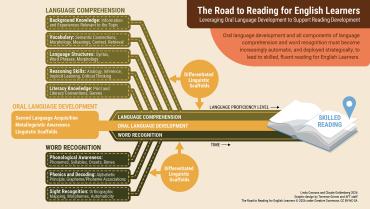
The Road to Reading for English Learners
Our model preserves the core, complementary duality of the reading process—word recognition and language comprehension—while framing the entire concept within the context of language acquisition. Scarborough’s original rope metaphor assumes that students are proficient in the language they are learning to read and builds on their existing language proficiency to teach them to read.
To address the language gap for ELs, our model structurally integrates two nonnegotiable sets of supports (highlighted in yellow in the graphic). One is oral language development, which represents a comprehensive English language development curriculum necessary for helping ELs become fully English-proficient orally and in literacy. The other comprises differentiated linguistic scaffolds to help build English literacy skills acquisition, for example, by providing English vocabulary instruction so that students learn and practice decoding with words they comprehend.
These structural innovations and conceptual additions are essential for ELs. Oral language development is a key primary component. Unlike the Simple View and models that followed, which assume oral language proficiency as a foundation, our model requires explicit, systematic instruction in oral language development as a prerequisite for and ongoing partner to literacy development. Differentiated linguistic scaffolds are not offered as external supports but are an essential, interconnected part of instruction for every subskill across both the word recognition and language comprehension lanes.
Our model acknowledges that academic English proficiency develops over time and depends on a student’s current level. Research consistently shows it typically takes four to seven years of quality instruction for ELs to reach the advanced academic language proficiency necessary for school success.8 This extended timeline, much longer than the time required to acquire social English proficiency, reflects the high cognitive demand of mastering complex academic vocabulary and grammar. It’s important for teachers to keep this multiyear gap between social and academic English in mind; if they don’t, they may not appreciate the progress that students are making.
Understanding an EL’s specific proficiency levels in listening, speaking, reading, and writing is critical for effective literacy instruction because it forms the basis for academic achievement.9 This assessment helps educators distinguish between reading difficulties rooted in language proficiency and those indicating a distinct reading challenge. This knowledge must guide targeted, differentiated linguistic and academic support to help ELs become proficient readers.

Unpacking the Road to Reading for English Learners
Let’s examine how to integrate oral language development and differentiated linguistic scaffolds into the language comprehension and word recognition lanes, which are at the heart of literacy acquisition and development. Throughout all language and literacy instruction, the needs of ELs should be emphasized using differentiated linguistic scaffolds that support their reading growth.
Empirical evidence for many of the features we describe here is inconsistent.10 Yet, as a group, these features help communicate the types of support ELs are likely to need as they acquire the English language skills required for success in English literacy and in school academics more generally.
Oral Language Development
Separating oral language development as a primary, distinct lane reflects the crucial reality that ELs are developing the language of instruction alongside literacy skills. This development must be systematic, goal-oriented, and tied directly to the literacy skills and content being taught.
Second Language Acquisition
Second language instruction for ELs must be based on principles of second language acquisition. All teachers of ELs should understand the stages ELs go through as they learn a second language. (Those who are not familiar with the stages can read about a commonly cited conception here.) There are regularities in the developmental trajectory of second language acquisition that parallel first language acquisition,11 although there are also differences between how first and second languages are acquired and develop.12 ELs must receive language instruction aligned with or just above their current language skills to ensure understanding; if the language used is too advanced, they might not comprehend it without additional supports and context.
Therefore, two key instructional focuses for second language acquisition are setting explicit language goals for every lesson to guide students to the next level of proficiency, and recognizing that the home language serves as a foundation for learning English.13 Teachers should support oracy development by providing rich language interaction and structured dialogue opportunities, such as using sentence frames (e.g., “I agree with __________ but also think __________.”) to encourage sophisticated academic language practice.14
Metalinguistic Awareness
Equally important is the explicit teaching of metalinguistic awareness, which involves instructing ELs to think about and manipulate language forms consciously.15 This encompasses:
- Cross-linguistic transfer: Teaching students to utilize connections between their home language and English, such as cognate awareness (e.g., cartilage and cartílago).16
- Contrastive analysis: Explicitly identifying, analyzing, and comparing linguistic features (sounds, grammar, and vocabulary) across the first and second languages to anticipate and address common areas of confusion or difficulty.
Differentiated Linguistic Scaffolds
Differentiated linguistic scaffolds are pedagogical tools that make instruction comprehensible while maintaining the cognitive rigor of the task.17 They are fundamentally integrated into the Road to Reading model, ensuring that the necessary rigor of foundational literacy skills is made accessible.† Scaffolds are categorized into four types:
- Language: These scaffolds directly modify input and output. Examples include simplifying grammar and syntax, slowing speech, allowing more time for language processing, and using consistent language. Language scaffolds ensure that the instruction is comprehensible.
- Teacher: These scaffolds involve the teacher’s use of instructional strategies, such as consistently maintaining high expectations in a safe, supportive environment; structuring flexible grouping (partners, triads, mixed-proficiency groups); controlling task difficulty; and leveraging ELs’ life experiences and cultural knowledge as instructional anchors.
- Classroom: These scaffolds refer to the physical and environmental features of the classroom. Effective classrooms are print-rich, featuring labeled objects (words and photos), bilingual word walls, multi-language libraries, and bilingual dictionaries with images and illustrations.
- Visual and concrete: These nonlinguistic scaffolds link language to meaning. They include pictures, graphic organizers (such as diagrams, charts, and graphs), real-life objects (realia), and manipulatives. The use of Total Physical Response is an important concrete scaffold (for details, see here).

Word Recognition
Instruction in the word recognition lane must be systematic and explicit yet, to the extent possible, build on transferable orthographic features of the EL’s primary language. ELs need to understand the meanings of the words they are decoding and the function of the letters in words to recognize the utility of what they know and can transfer from their first language.
Phonological Awareness
Instruction in phonological/phonemic awareness must be provided explicitly in the language(s) of instruction, although phonemic awareness acquired in one language transfers to phonemic awareness in another.18 When taught in a second language, the gradual release approach can be used, but the level of focus must be differentiated:
- For students learning English, instruction should focus on awareness at the phoneme level of words (e.g., phoneme blending, segmentation, and manipulation) because English has a deep, phoneme-based orthography.
- If learning in Spanish,‡ once students have learned the five vowels—each of which has one and only one associated phoneme—instruction proceeds by introducing one consonant at a time to build syllables, which are then joined to form words. The transparency of Spanish orthography makes an explicit focus on phoneme awareness less necessary, though some students will still need it.19
Teachers must use definitions, visuals, demonstrations, and other strategies to ensure ELs understand the words used to teach all word recognition skills.20 In addition, the language used to talk about reading and reading instruction, such as blending, segmenting, and rime, cannot be assumed but must be explicitly taught.21 ELs might not naturally understand words such as blend or segment when used to describe letter-sound relationships. Assuming they know these concepts when in fact they do not can lead to confusion and slow reading progress.
Phonemic awareness instruction for ELs learning to read in English should be explicit, systematic, and multimodal, while strategically leveraging their home language.22 Use manipulatives like tokens or Elkonin boxes (which you can learn more about here) to represent phonemes, allowing students to segment and blend sounds. Teachers should be aware of possible pronunciation differences and accept approximations, a close but not exact word, as students learn to hear and produce new phonemes.
Phonics and Decoding
Phonics and decoding instruction for ELs, as for any student, must be explicit, systematic, and tied to meaning. This systematic approach involves directly teaching letter-sound connections (grapheme-phoneme correspondences) in a carefully sequenced order, starting with the simplest patterns.23 In English, decoding instruction is complex and demanding, requiring clear teaching of syllable types (closed, open, VCe, R-controlled vowels, vowel teams, and C-le) to support both decoding and encoding. The focus is on mastering the alphabetic principle and achieving orthographic mapping.24 In Spanish, because orthography is more transparent, syllables are usually learned quickly after the vowels are taught and individual consonants are introduced one by one, shifting the main decoding focus to multisyllabic words. Spanish phonics often emphasizes teaching letters to form syllables first, then combining syllables to make words and read connected text.
For effective decoding, instruction should include hands-on activities such as magnetic letters, word-building, and finger-tapping to reinforce the connections between the sound, the visual letter, and the act of writing. Words used for decoding practice, especially in decodable texts, should be familiar to students. Explicitly teach the meaning of any unknown words, including cognates (words that look alike, mean the same thing, and come from the same origin), before asking the student to sound them out. This practice ensures that ELs are not just sounding out words but are connecting the spelling and pronunciation of decoded words to achieve orthographic mapping, then associating the mapping to word meanings to put the written word into long-term memory. A word becomes immediately recognizable without needing to be decoded letter by letter after one, several, or many exposures to the written word, depending on a reader’s skill.25
Sight Recognition
For ELs, as for all students, sight recognition—the quick and automatic identification of words, sometimes called instant or “heart” words (i.e., words learned by heart)26—is closely linked to understanding the alphabetic principle, orthographic patterns, and word pronunciations and meaning. A growing bank of these words is essential for successful, fluent reading.
Teachers should promote sight recognition by having ELs initially decode words using their knowledge of grapheme-phoneme relationships, then verify accuracy with context and pictures to ensure ELs understand the words’ functions and can anchor them to sight-word recognition.27 This method strengthens the essential link among a word’s pronunciation, spelling, and meaning. Teachers should teach both high-frequency words (phonetic and irregular) and high-utility words (complex academic vocabulary). Most words, with few exceptions (e.g., of, who), have some phonetic features that conform to orthographic patterns, so decoding is relevant for irregular words as well. Teachers need to point out the features of these words that do not follow orthographic patterns yet still connect spelling to pronunciation by using orthographic mapping then associating that mapping with the words’ meanings.
Language Comprehension
The language comprehension lane demands more strategic skills. This instruction is more open-ended and focuses on discourse, requiring the ongoing and extensive use of linguistic scaffolds throughout its components.
Background Knowledge
The acquisition and activation of background knowledge are essential for bridging the comprehension gap often faced by ELs due to limited exposure to academic content in English and the absence of their experiences in most textbooks. Instruction must begin by activating the students’ existing knowledge—often using visuals, realia, or home language support—and making connections to ELs’ lived experiences to validate their cultural assets and build a bridge to new academic concepts. Engaging ELs in discussions about the topic and asking scaffolding questions will help identify and connect existing knowledge to new concepts.28 Teachers can enhance ELs’ background knowledge by providing introductory information through various modalities (e.g., orally, text, pictures, anchor videos, and graphic organizers) to actively develop their conceptual understanding. Using graphic organizers is a vital visual scaffold for organizing complex facts.29
Vocabulary
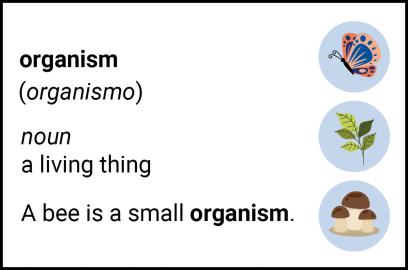
Vocabulary instruction is a crucial point where language learning and literacy intersect. Effective strategies include giving a clear, student-friendly definition,30 the part of speech, and a visual for each new word.31 When possible, teachers can support understanding by using a cognate or a simple definition in the home language. (See the figure below for a vocabulary word card for ELs with the recommended components.) Teachers can also model using the word in sentences and, to reinforce retention, provide ELs with plenty of practice using it orally and in writing, including incorporating it into new sentences and conversations.32
In addition to explicit teaching of individual words, morphological awareness should be a key component of vocabulary instruction for ELs. Explicitly teaching common affixes (prefixes and suffixes) and roots helps ELs decode and infer the meanings of a vast number of unfamiliar words, allowing them to rapidly expand their vocabularies, especially in academic contexts.33 For example, teaching the prefix un- helps a student quickly unlock the meanings of words like unhappy, unfamiliar, and unacceptable, which builds their sense of control over the language and encourages independent learning. Instruction should be systematic, focusing on high-utility morphemes that appear across multiple academic subjects (e.g., prefixes such as un- and re- and suffixes such as -tion and -able) before students are asked to apply them independently.34 When students already know a morpheme in their home language, they can use it to figure out the meaning of a new English word.
Language Structures
Language structures focus on the explicit teaching of syntax and semantics—the rules that govern sentence structure and language meaning. Strategies for ELs must help make these abstract concepts concrete by, for example:
- Helping ELs form sentences using newly learned vocabulary and allowing them to manipulate familiar words using sentence frames (e.g., “The author suggests that __________ because __________.”).
- Explicitly teaching semantic awareness tools, such as homophones (e.g., plain, plane) and synonyms (e.g., important, essential, critical).
- Focusing on increasingly complex yet useful language structures. Simple sentence manipulation, such as identifying the subject and verb in an action using visuals (e.g., “Who is talking on the phone? José is talking on the phone.”), is a fundamental step for developing language skills.
Teachers should focus on helping ELs identify and use cohesive devices (e.g., transition words like however, consequently, and in addition, or referents like pronouns) that link ideas across sentences and paragraphs to create fluent, meaningful text. This instruction helps ELs move beyond simple sentence construction to grasp how complex thoughts are organized in academic discourse, which is essential for both understanding sophisticated texts and producing coherent writing.
Verbal Reasoning
Verbal reasoning involves inference, metaphor, analogy, and critical thinking. For ELs, instruction must be tied to robust oral language development to support the necessary reasoning process, often using conditional or comparative language (e.g., if/then, on the other hand).35 Ideally, teachers will:
- Explicitly teach inferencing terms frequently found in questions (e.g., most likely, mainly show, probably, figure out).
- Use scaffolding questions to help students make inferences, such as “What might have happened? It might __________,” using simple, concrete examples (e.g., “I think it probably rained” when looking at a wet sidewalk).
- Explicitly teach literary devices and figures of speech, including metaphors, similes, and idioms, as these are often culturally bound and nonliteral.
Literacy Knowledge
Literacy knowledge includes print concepts, genres, and conventions. Strategies should be consistently modeled and made concrete. Use read-alouds and shared reading daily to explicitly teach print direction (left to right, top to bottom), the relationship between written and spoken language, and the use of punctuation. Culturally relevant texts increase ELs’ motivation to read because they can relate to or have similar experiences when multicultural characters are portrayed positively. It’s also helpful to incorporate books of different genres into the classroom library to enhance understanding of text structure. Using practical literacy tools, such as word-family games (e.g., BINGO, where clues are provided through definitions to connect oral vocabulary with written words), can also be effective.
Teachers should explicitly teach print concepts that may differ across languages, such as the directionality of writing or the function of various punctuation marks. Instruction should include focused comparison of text structures across genres (e.g., narrative vs. informational) to help ELs organize their thinking and anticipate content when reading different types of texts. Making these abstract concepts concrete through modeling and visual examples is essential.

Our attempts to introduce the core tenets of the Road to Reading for English Learners to nationwide audiences have received very positive feedback, confirming the educational community’s readiness for a framework that structurally integrates language acquisition with established reading science. Educators and administrators across the country have widely acknowledged the model’s value in moving the discussion of EL literacy beyond mere adaptation to a fundamental shift in instructional design. The clear depiction of a separate oral language development lane and the pervasive, nonnegotiable role of differentiated linguistic scaffolds have resonated with practitioners seeking a research-based and linguistically aware road map for their students.
This positive reception underscores a crucial need for a conceptual imperative that aligns the universal cognitive principles of reading with the practical, developmental realities of students learning a new oral language simultaneously with its written form. By explicitly factoring in language proficiency levels and the time required for language development, the model attempts to provide educators with guidance to set realistic expectations and deliver effective, goal-oriented, differentiated instruction to advance ELs toward skilled, fluent reading and English proficiency.
The Road to Reading for English Learners is not an auxiliary tool but a conceptual imperative for aligning the established pedagogical requirements of ELs learning to read in a language they are simultaneously learning to speak and understand. By depicting a separate oral language development lane and distinct differentiated linguistic scaffolds to support reading acquisition, the model elevates the discussion of EL literacy from mere adaptation to fundamental instructional design.
The model focuses on the essential task of providing the linguistic bridge that enables ELs to access knowledge of universally recognized cognitive skills. By explicitly addressing students’ language proficiency levels and the time required for language development, the Road to Reading for English Learners provides educators with a clear, comprehensive road map. It applies equally to teaching reading in any alphabetic language, providing an instructional framework that respects the orthography of the written language while ensuring all lanes are systematically taught and pulled together to promote skilled, fluent reading. The Road to Reading for English Learners offers a scientifically sound and linguistically aware adaptation of core reading tenets, smoothing the path to literacy for ELs.
Linda Cavazos is the executive director of English Learner Leadership Advocacy Support (ELLAS) Consulting. Previously, she was a bilingual teacher and reading interventionist in Texas. She conducted research and served as a response-to-intervention and multitiered system of support coach at the University of Texas at Austin. She has taught graduate courses in Texas and California. She wrote curricula for 10 years in both English and Spanish in the areas of reading, writing, math, science, and social studies for grades kindergarten through eighth. Claude Goldenberg, an emeritus professor in the Graduate School of Education at Stanford University, is a native of Argentina who taught junior high reading and history early in his career and bilingual first grade after graduate school. Previously, at California State University, Long Beach, he was a professor of teacher education, an associate dean of the College of Education, and the executive director of the Center for Language Minority Education and Research.
*To be clear: We are not advocating English-only literacy instruction for ELs. Far from it. We are both advocates for bilingual education that promotes bilingualism and biliteracy.4 The fact, however, is that a large majority of ELs are instructed primarily in English, and even those who receive bilingual instruction will learn to read and write in English as they learn to speak and understand it. (return to article)
†For an article with many examples of linguistic scaffolds, see “Supporting English Learners in General Education Classrooms” in the Winter 2025–26 issue of American Educator. (return to article)
‡Although we recognize and value the hundreds of languages students speak, we include tips for Spanish because it is the most widely spoken home language of ELs in the United States. (return to article)
Endnotes
1. K. Escamilla, L. Olsen, and J. Slavick, Toward Comprehensive Effective Literacy Policy and Instruction for English Learner/Emergent Bilingual Students (National Committee for Effective Literacy for Emergent Bilingual Students, February 2022), multilingualliteracy.org/wp-content/uploads/2022/04/21018-NCEL-Effective-Literacy-White-Paper-FINAL_v2.0.pdf.
2. H. Alvarez-Marinelli et al., Effective Reading Instruction in Low- and Middle-Income Countries: What the Evidence Shows (Global Education Evidence Advisory Panel, December 2025), documents1.worldbank.org/curated/en/099448110272527300/pdf/IDU-740c63ca-259a-4fae-8d95-7935242a25db.pdf?utm_source=substack&utm_medium=email; D. August and T. Shanahan, eds., Developing Literacy in Second-Language Learners: Report of the National Literacy Panel on Language-Minority Children and Youth (Lawrence Erlbaum Associates, 2006); and C. Goldenberg, “Unlocking the Research on English Learners: What We Know—and Don’t Yet Know—About Effective Instruction,” American Educator 37, no. 2 (Summer 2013): 4–11, 38.
3. C. Goldenberg, “The ‘Bilingual Brain’ and Reading Research: Questions About Teaching English Learners to Read in English,” Colorín Colorado, 2023, colorincolorado.org/article/bilingual-brain-and-reading-research-questions-about-teaching-english-learners-read-english.
4. L. Cavazos, The Science of Reading for Emergent Bilinguals in New Mexico: A Review for the New Mexico Public Education Department (New Mexico Public Education Department, November 2021), web.ped.nm.gov/wp-content/uploads/2025/01/The-Science-of-Reading-for-Emergent-Bilinguals-in-New-Mexico_Jan-2022-.pdf; C. Goldenberg and K. Wagner, “Bilingual Education: Reviving an American Tradition,” American Educator 39, no. 3 (Fall 2015): 28–32, 44 (Spanish version: “La educación bilingüe: Reviviendo una tradición americana,” aft.org/ae/fall2015/goldenberg_wagner_es; and C. Goldenberg and E. Cárdenas-Hagan, “Literacy Research on English Learners: Past, Present, and Future,” Reading League Journal 4, no. 1 (January/February 2023): 12–21, edsource.org/wp-content/uploads/2023/05/Literacy-Research-on-English-Learners.pdf.
5. H. Scarborough, “Connecting Early Language and Literacy to Later Reading (Dis)abilities: Evidence, Theory, and Practice,” in Handbook of Early Literacy Research, ed. S. Neuman and D. Dickinson (Guilford Press, 2001), 97–110.
6. P. Gough and W. Tunmer, “Decoding, Reading and Reading Disability,” Remedial and Special Education 7 (1986): 6–10.
7. L. Cavazos and C. Goldenberg, “Reconceptualizing the Reading Rope to Leverage Multilingual Learners’ Bilingualism as a Superpower,” conference presentation, National Association for Bilingual Education Conference, Atlanta, GA, February 2025.
8. J. Cummins, “The Role of Primary Language Development in Promoting Educational Success for Language Minority Students: A Theoretical Framework,” in Schooling and Language Minority Students: A Theoretical Framework (Evaluation, Dissemination, and Assessment Center, California State University, Los Angeles, 1981), 3–49; F. Genesee et al., Educating English Language Learners: A Synthesis of Research Evidence (Cambridge University Press, 2006); K. Hakuta, Y. Butler, and D. Witt, How Long Does It Take English Learners to Attain Proficiency? (University of California Linguistic Minority Research Institute, January 2000); and W. Thomas and V. Collier, A National Study of School Effectiveness for Language Minority Students’ Long-Term Academic Achievement (Center for Research on Education, Diversity & Excellence, 2002).
9. Genesee et al., Educating English Language Learners; and R. Scarcella, Academic English: A Conceptual Framework (University of California Linguistic Minority Research Institute, 2003), escholarship.org/uc/item/6pd082d4.
10. C. Goldenberg, “Teaching English Language Learners: What the Research Does—and Does Not—Say,” American Educator 32, no. 2 (Summer 2008): 8–23, 42–44; Goldenberg, “Unlocking the Research”; and W. Saunders, C. Goldenberg, and D. Marcelletti, “English Language Development: Guidelines for Instruction,” American Educator 37, no. 2 (Summer 2013): 13–25, 38–39.
11. R. Ellis, Understanding Second Language Acquisition, 2nd ed. (Oxford University Press, 2015).
12. P. Lightbown and N. Spada, How Languages Are Learned, 5th ed. (Oxford University Press, 2021).
13. E. Coelho, Adding English: A Guide to Teaching in Multilingual Classrooms, 2nd ed. (University of Toronto Press, 2016).
14. S. Baker et al., Teaching Academic Content and Literacy to English Learners in Elementary and Middle School (National Center for Education Evaluation and Regional Assistance, Institute of Education Sciences, US Department of Education, 2014), ies.ed.gov/ncee/wwc/Docs/practiceguide/english_learners_pg_040114.pdf; and TESOL International Association. (2018). The 6 principles for exemplary teaching of English learners: Grades K–12.
15. T. Odlin, Language Transfer: Cross-Linguistic Influence in Language Learning (Cambridge University Press, 1989).
16. K. Koda, Insights into Second Language Reading: A Cross-Linguistic Approach (Cambridge University Press, 2005); and A. Gottardo, X. Chen, and M. Huo, “Understanding Within- and Cross-Language Relations Among Language, Preliteracy Skills, and Word Reading in Bilingual Learners: Evidence from the Science of Reading,” Reading Research Quarterly 56, no. S1 (May 2021): S371–90.
17. J. Echevarria et al., Making Content Comprehensible for Multilingual Learners: The SIOP Model, 6th ed. (Pearson, 2024).
18. C. Goldenberg et al., “How Important Is Teaching Phonemic Awareness to Children Learning to Read in Spanish?,” American Educational Research Journal 51 (2014): 604–33.
19. Goldenberg et al., “How Important Is Teaching Phonemic Awareness.”
20. Echevarria et al., Making Content Comprehensible.
21. R. Berry, “Making the Most of Metalanguage,” Language Awareness 14, no. 1 (2005): 3–20; and E. Bialystok, Bilingualism in Development: Language, Literacy, and Cognition (Cambridge University Press, 2001).
22. August and Shanahan, eds., Developing Literacy; L. Cavazos, New Mexico Public Education Department Biliteracy Guidance: The Science of Reading for English Learners (New Mexico Public Education Department, August 2022); and D. Rehfeld et al., “A Meta-Analysis of Phonemic Awareness Instruction Provided to Children Suspected of Having a Reading Disability,” Language, Speech, and Hearing Services in Schools 53, no. 4 (2022): 1177–201.
23. E. Cárdenas-Hagan, Literacy Foundations for English Learners: A Comprehensive Guide to Evidence-Based Instruction (Brookes Publishing, 2020); Cavazos, New Mexico Public Education Department Biliteracy Guidance; G. Correro et al., Teaching Children to Read: An Evidence-Based Assessment of the Scientific Research Literature on Reading and Its Implications for Reading Instruction (National Reading Panel, National Institute of Child Health and Human Development, 2000), nichd.nih.gov/sites/default/files/publications/pubs/nrp/Documents/report.pdf; and Rehfeld et al., “A Meta-Analysis of Phonemic Awareness.”
24. L. Ehri, “Orthographic Mapping in the Acquisition of Sight Word Reading, Spelling Memory, and Vocabulary Learning,” Scientific Studies of Reading 18, no. 1 (2014): 5–21.
25. Reading Rockets, “Basics: Sight Words and Orthographic Mapping,” readingrockets.org/reading-101/reading-and-writing-basics/sight-words-and-orthographic-mapping.
26. L. Farrell, M. Hunter, and T. Osenga, “A New Model for Teaching High-Frequency Words,” Reading Rockets, readingrockets.org/topics/phonics-and-decoding/articles/new-model-teaching-high-frequency-words.
27. L. Ehri et al., “Reading Rescue: An Effective Tutoring Intervention Model for Language-Minority Students Who Are Struggling Readers in First Grade,” American Educational Research Journal 44, no. 2 (2007): 414–48.
28. Echevarria et al., Making Content Comprehensible; M. Romero and L. Cavazos, “Culturally and Linguistically Responsive Interventions to Support Emergent Bilingual Students’ Language and Literacy,” in Culturally and Linguistically Responsive Intervention and Assessment Practices with Emergent Bilingual Students, ed. D. Vega and J. Wolf (Springer Nature Switzerland, 2025), 111–29.
29. Cavazos, New Mexico Public Education Department Biliteracy Guidance; and Romero and Cavazos, “Culturally and Linguistically Responsive Interventions.”
30. I. Beck, M. McKeown, and L. Kucan, Bringing Words to Life: Robust Vocabulary Instruction (Guilford Publications, 2013).
31. Romero and Cavazos, “Culturally and Linguistically Responsive Interventions.”
32. Romero and Cavazos, “Culturally and Linguistically Responsive Interventions.”
33. A. Goodwin and S. Ahn, “A Meta-Analysis of Morphological Interventions in English: Effects on Literacy Outcomes for School-Age Children,” Scientific Studies of Reading 17, no. 4 (2013): 257–85; and Crosson, A. C., McKeown, M. G., & Binzak, J. V. (2024). Cross-Language Morphological Analysis Improves Academic Word Learning for Multilingual Adolescents. Reading Research Quarterly.
34. L. Hennenfent et al., Intensive Intervention Practice Guide: Explicit Morphology Instruction to Improve Overall Literacy Skills in Secondary Students (National Center for Leadership in Intensive Intervention, Office of Special Education Programs, US Department of Education, 2022), files.eric.ed.gov/fulltext/ED628200.pdf.
35. Cavazos and Goldenberg, “Reconceptualizing the Reading Rope.”
36. 36. Project ELLIPSES, Project LEE, and Project ELITE, Meeting the Needs of English Learners With and Without Disabilities (US Office of Special Education Programs, US Department of Education, 2020), mtss4els.org/files/resource-files/Series2-Brief2_Final.pdf.
[Illustrations by Katie Lukes]