 Member Benefits
 How to Join
 En Espanol

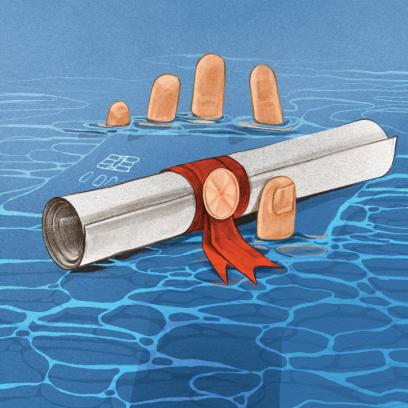
In this special issue of American Educator, several economists and researchers answer a fundamental question: Why is it so hard to make ends meet? While the full story is complex, there are two simple truths we should all keep in mind. First, wages haven’t risen as quickly as they could and should have since the late 1970s; instead, as productivity rose, the gains went primarily to the people who were already ultra-wealthy. Second, a variety of policy choices—including on taxes and trade—are forcing working people into debt for basic necessities like housing, higher education, and healthcare.
The scholars’ explanations offer critical insights, but we wanted to start with our members: What does our inequitable economy—and the resulting affordability crisis—mean for them? Few people want to talk about being in debt; even though our society is structured to make debt all but impossible to avoid, it seems like anything beyond a mortgage is taboo. We’re grateful to Mary Elizabeth Modica, a seventh-grade English language learner educator and member of the Clarkstown Teachers’ Association in New City, New York, and Thomas Moomjy, an American studies professor at Rutgers University and member of the Rutgers Adjunct Faculty Union in New Brunswick, New Jersey, for sharing their stories.
–EDITORS
EDITORS: Please tell us about yourselves, including how you were pushed into debt.
THOMAS MOOMJY: I’ve been an adjunct professor since 2010. I teach American studies, and my specialty is pop culture and web culture.
In 2019, I got hit with walking pneumonia. I passed out, woke up in the emergency room, and by the time I could go home a couple of days later, I had a $35,000 bill. I did not have insurance—as an adjunct, I could not afford it. The irony is that I was working full time between my classes at the two state institutions where I was teaching: Rutgers University and Raritan Valley Community College. In a more just world, I should have been getting health insurance. New Jersey uses a look-back method for determining benefits; because I was working full time in 2019, I got insurance in 2020. But that’s rare. Of the 16 years that I have been an employee of the state of New Jersey, I’ve only had state health benefits for two years.
To pay off my medical debt, I gave up the money I had been saving to buy a house—and seven years later I’m still renting. This year, I’m without health insurance again because of President Trump’s supposedly beautiful bill eliminating the subsidies that made buying insurance under the Affordable Care Act actually affordable.* Last year, with the subsidy, my payment was $150 per month. This year, if I had kept my insurance, it would be over $750.
This is a policy choice that Republican legislators made. I’m furious. But I have reasons to be furious at both sides; both have made policy choices that put working people last. Looking ahead to the midterms, I wish there were more candidates who would get something done in a nonideological way. Give me a candidate who has a reasonable solution to fiscal problems instead of kicking the can down the road to the next generation. I don’t want to pass on problems like they were passed on to my generation.
The best thing that happened to me over the past several years was connecting with people on debt issues, including student debt, and qualifying for Public Service Loan Forgiveness (PSLF) last year. As an adjunct, that is like a miracle, and it has given me much-needed breathing room.
Currently, thanks to union solidarity, I’m only teaching at Rutgers. In 2023, Rutgers faculty and graduate students went on strike. As a result, my salary went up and now I can get by—just barely—with one job. But I still teach more courses than tenured professors. And I’m waiting for the other shoe to drop. It almost did in the middle of March; the deans said we had to pause our budget and started making cuts. I received a letter on a Friday thanking me for my service, then was rehired the following Monday. Maybe someone realized that I was already on the schedule for summer and fall classes.
Right now, I have my head above water, which is amazing considering the past seven years. But I have no means to save or get ahead. And if I get sick today, I’ll be back to where I was in 2019. I remember what it’s like to be below water, and I’m absolutely terrified. Who knows what’s next?
MARY ELIZABETH MODICA: It’s very comforting to hear your story because I don’t feel as alone. At 18, when I went off to college, I wanted to be a radio deejay. I didn’t understand that the industry was consolidating and jobs were disappearing. After graduating with a degree in audio engineering in 2006, I moved to Hollywood and worked for a company that manages artists. But once my student loans went into repayment, I was spinning into debt for everyday expenses. I bought groceries at the dollar store and gave up my apartment—I was reduced to renting a couch to sleep on.
Soon I packed up what was left of my life and drove back to my parents’ house in New York, heartbroken. Through networking, I found a job at a social media start-up, where I got to use my audio engineering skills and serve as the office manager. Then Bear Stearns went under in 2008, and it was like a domino effect. Since the people hired after me were being let go, I knew I was going to lose my job.
My mom suggested I go to graduate school during the recession, so I found a subsidized master’s program that sent me to London and got an international MBA. But when I graduated in December 2010, the economy was still awful. Moving back in with my parents, I was a gig worker for events and did social media consulting. I became an EMT, making about $36,000 per year. A few years later, I learned about the New York City Teaching Fellows program and completed a second subsidized master’s degree.
I love teaching, but I’m drowning in debt. I borrowed about $80,000 for my education, but today I owe over $100,000. I’m hoping to qualify for PSLF soon—I have 12 years of public service as an EMT and teacher—but the program administrators have made it a struggle. Due to a combination of their errors and misinformation, they claim that many of my payments don’t count toward the 120 required. Fortunately, the AFT is helping me.†
Making my situation even more challenging, I was diagnosed with a connective tissue disorder last year, so I’ve had to go to a ton of specialists. I have health insurance through my school district, but it doesn’t cover copays, the physical therapy I need, or other necessities like compression garments. I have $20,000 in medical debt from less than a year’s worth of just these costs associated with my care.
The hardest part of everything I’ve been through is that I didn’t have children because I could barely afford my own life. Now it’s too late, which is devastating because I love children.
THOMAS: Life wasn’t supposed to be this hard. For every step forward, there are two steps back.
EDITORS: Economists have explained‡ that if wage and benefit growth for typical workers had kept up with productivity growth since the 1980s, middle-income workers would now make almost $23,000 more per year. What would that mean for you?
THOMAS: I think it would mean breathing room. My stepmother was a public school teacher. My stepfather was a mail carrier. For them and their generation, public service wages were not great, but the benefits were really good. The United States has been moving away from that promise; now, neither the pay nor the benefits are good.
I spoke with a friend recently about feeling stuck. He told me, “I wish I had an extra $20,000 or $30,000.” People hope to have $1,000 in case of an emergency, but the reality is we need more than that.
MARY ELIZABETH: Having the additional $23,000 a year that working people are owed would mean being able to afford my mortgage and student loans. And I would be able to regularly see the specialists I need to address my autoimmune disease—and even afford the physical therapy, compression garments, and healthy food they recommend.
THOMAS: We need more conversations like this, where more people start talking about our struggles. When we tell our stories, it seems like there’s a judgment: You’re a failure because of your debt.
MARY ELIZABETH: It’s so hard to remember that I’m not a failure.
THOMAS: We’re not failures. We have a system stacked against us. We need a new deal guaranteeing basic needs, like health insurance and a roof over one’s head. We need a new deal that makes “life, liberty, and the pursuit of happiness” real.
MARY ELIZABETH: I agree. The American dream is now just a fantasy.
EDITORS: The challenges you’re facing are the result of policy choices;§ other wealthy countries make higher education and healthcare accessible. Are you hopeful that the United States will make life easier for working families?
THOMAS: Ever since Citizens United, when the US Supreme Court ended limits on corporate spending in politics, it feels like our voices do not matter. There’s only one question: Can you pay? I think that has led to apathy among younger people. To move forward, to even consider what our peer nations provide for their citizens, requires a sense of collective sacrifice.
The ultra-wealthy are not going to hand anything to us. They’re not going to suddenly become benevolent and agree to higher taxes. Regular people are going to have to be in the streets demanding a collective sense of shared responsibility. It’s going to require making hard choices that not everyone is comfortable with.
But Mary Elizabeth and I have been making hard choices our entire adult lives. I don’t see any hope for my life becoming much easier, so my goal is for life to not be as hard for the next generation. Our children’s future is what we should be fighting for.
MARY ELIZABETH: In an interview recently, Morris Pearl, the chair of Patriotic Millionaires and a former managing director of BlackRock, said, “I want my tax rates to be higher…. I’d have a little bit less of a balance in one of my accounts somewhere, and it wouldn’t change what I do. It wouldn’t change where I eat. It wouldn’t change where I go on vacation.”** In contrast, when Thomas and I were talking about what we would do with an extra $23K, eating out and vacation didn’t even come up.
If taxing billionaires won’t affect them, why do they care so much? Morris gave the example of football teams that keep playing hard even though they’re winning handily; they want the biggest score possible to boost their sense of self-worth. That says a lot about American culture. We emphasize the wrong things to our children, to our neighbors. We’ve lost the plot of humanity.
We need much higher taxes on the ultra-wealthy. We should not let greed dictate how we take care of each other—and we could afford to if the wealthiest among us paid their fair share. It hurts to pay my taxes, but I do it because I believe that we are all working toward a common good. For billionaires, the tax rate should be whatever is necessary for them to also find paying their taxes painful.
THOMAS: We need a different sense of shame in our country. I feel ashamed that my public student loan forgiveness went through and Mary Elizabeth’s didn’t. But these billionaires don’t feel ashamed at all, whether they are taking government bailouts like during the Great Recession or lobbying legislators to make their taxes even lower.
It’s a real problem that so many unions today are public sector unions. We need a lot more examples of effective solidarity. The people of Minnesota showed that they could come together under the threat of Immigration and Customs Enforcement, but we shouldn’t be provoked into responding only in crisis situations. We need to be able to respond strategically to address issues that have been endemic for 40 or 50 years now, such as extremely slow wage growth for regular workers.

EDITORS: How do your experiences affect you as active citizens and voters?
MARY ELIZABETH: In 2021, I became a Working Families Party member. My reason why is in the name—it represents exactly what I am and what I value. But that change wasn’t enough. I realized that I needed to become a stronger advocate in my local political environment. Fighting for school funding is one of my core issues. We still have schools with lead pipes and asbestos tiles. How can that be?
I also share my story everywhere that I can—including testifying before Congress—to try to move this conversation another step forward, to show how these issues are causing real harm to people.
THOMAS: I think it’s important that we channel our stories and emotions into not just voting but also action. I’ve also become more active, and I’ve testified at the New Jersey Legislature multiple times about the rising cost of living, debt, and inequality. Of course, I’d rather be doing something else with my spare time, but as my generation is learning, the only way to accomplish anything is to get involved and do it yourself.
MARY ELIZABETH: I really want to speak to the American public: It’s not only about you. It’s about all of us together. We’re in this together.
THOMAS: E pluribus unum: “Out of many, one.” There are a lot of reasons to critique this country. But the idea that we could solve our problems through collective debate and governance is really brilliant. The problem is that we stopped doing it. So now we have to fight for a Congress that will get back to work.
*To learn about these cuts, see “What Donald Trump’s Second Presidency Has Meant for Health” in the Spring 2026 issue of AFT Health Care. (return to article)
†To learn about PSLF and the AFT’s student debt clinics and resources, see here. (return to article)
‡See “Wages, Inequality, and the Roots of America’s Affordability Crisis.” (return to article)
§See “Debt, Opportunity, and Persistent Inequality.” (return to article)
**To watch the interview, see here. (return to article)
[Illustrations By Ūla Šveikauskaitė]