 Member Benefits
 How to Join
 En Espanol
We shall overcome, again
The new Jim Crow uses rigged maps and partisan Supreme Court decisions to disenfranchise voters of color.
The six justices on the U.S. Supreme Court appointed by Republican presidents have just gutted what remained of the landmark 1965 Voting Rights Act. At the heart of the case, Louisiana v. Callais, is a congressional map that finally allowed Black voters in Louisiana, who constitute one-third of the electorate, to elect representatives of their choice and to have a say in decisions that affect their lives. Writing for the majority, Justice Samuel Alito asserted that “vast social change” showed that certain protections of the act were no longer necessary. But the events of the two weeks since that decision prove the need for the voting rights protections the court struck down.
Whereas the old Jim Crow used poll taxes, literacy tests and whites-only primaries, the new Jim Crow uses gerrymandered maps, voter roll purges, polling place intimidation and closures, and Supreme Court rulings like Callais that make it legal to disenfranchise voters of color.
With this green light from the Supreme Court, the governor of Louisiana just suspended a primary election even after 45,000 ballots had been cast, calling it “an election emergency.” Tennessee’s Republican-controlled Legislature eliminated the state’s only Democratic, Black-majority district in Memphis, and then targeted every legislator who protested the power grab by stripping them of their committees. Lawmakers in Alabama were undeterred by tornado sirens and flooding in the state Capitol as they rammed through bills to dilute the power of Black voters. And even though the South Carolina Senate, with the support of several Republicans, declined to redraw the state’s congressional map despite pressure from President Donald Trump, the governor is pushing a gerrymander to wipe out the lone Democrat in the state’s congressional delegation.
This race to redistrict—and the unusual move to redistrict mid-decade—is all about power. Trump and his allies face near-certain losses in the midterm elections, given his dismal poll ratings on the cost of living, the state of the economy, and the unpopularity of many of his policies, including indiscriminate immigration enforcement and starting the Iran War.
This is an affront to two fundamental values of our country as we mark the 250th anniversary of our founding. The first is that the people should decide who their elected representatives are, not the other way around. When voters in Memphis are now divided into three separate, Republican-leaning districts, redrawn to include rural, suburban and far-reaching areas, you know this is about grabbing power, not about the people’s choice.
Second, this redistricting effort is turning the clock backward. It erases generations of sacrifice and struggle to make our nation embody its founding ideals. The race to eliminate majority-minority districts denies Americans the constitutional protections of the 14th Amendment’s antidiscrimination provisions and equal protection clause and the safeguards in the Voting Rights Act to secure political equality in our multiracial society.
The reversal of 60 years of progress in voting rights reopens raw wounds, but it doesn’t come as a surprise to many veterans of the civil and voting rights movements. Doris Crenshaw, now 83, started organizing for voting rights at age 12 with Rosa Parks. When the Supreme Court gutted the Voting Rights Act, she says she was expecting it. “They’ve been working on getting rid of it almost since the bill was passed,” Crenshaw said. “We’ve got to register people to vote like … never before. We’ve got to put fire in the hearts of people who are registered but do not vote. We’ve got to encourage white people and Black people and people of all colors to turn out.” I couldn’t agree more.
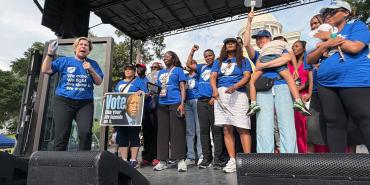
This weekend in Alabama, we joined a powerful coalition of civil and voting rights, faith, labor and community organizations in an All Roads Lead to the South day of action to protest attacks on voting rights. Too much blood has been shed and too many lives lost to allow extremists on the Supreme Court and in state legislatures to continue their rampage against multiracial democracy. Everyone should be outraged that, in the United States today, there are many people with fewer rights now than their grandparents had.
My union is proud to build on our history of fighting to expand rights for all Americans. The AFT was the only union to file an amicus brief in Brown v. Board of Education. In the 1950s, the AFT expelled all local unions that refused to desegregate. This is another moment for moral clarity and action. This is an imperative for the AFT as educators, a union and a champion for civil rights. And it is an imperative for all Americans seeking to create a more perfect union. We must stand up against injustice. And when we do, we shall overcome, again.