 Member Benefits
 How to Join
 En Espanol
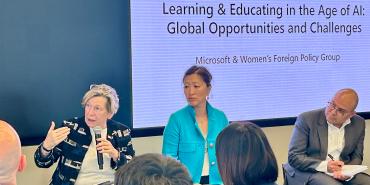
At a panel on the use of artificial intelligence in schools, Ambassador Sangjin Kim, South Korea’s deputy permanent representative to the United Nations, shared a candid personal story that brought the stakes into focus.
His son had used ChatGPT to prepare for a world history test. Father and son then sat down to review. But when his son had to connect decolonization to the collapse of the Cold War, he drew a blank. AI had helped him gather information, Kim said, but it had not helped him think deeply about what the information meant and how to apply it.
The story humanized the focal point of the panel discussion: AI can appear helpful when it comes to knowledge acquisition, but it cannot teach knowledge application, and its impact on a child’s ability to think critically can be profound. But it is here. So how do schools ensure that AI supports education without replacing the thinking and human judgment that sets the scene for learning?
In addition to Kim, the panel, hosted by Microsoft and the Women’s Foreign Policy Group, included AFT President Randi Weingarten; Ambassador Jay Dharmadhikari, the deputy permanent representative of France to the United Nations; Naria Santa Lucia, a general manager of Microsoft’s Elevate initiative; and Juan-Pablo Giraldo, an education and innovation specialist with UNICEF.
Weingarten, like Kim, noted that the stakes cannot be overstated. AI is catalyzing the largest societal transformation we have ever seen, she said, even more significant than the introduction of the printing press. But in education, we have to be adamant from the start: AI can support teaching and learning, but it cannot replace teachers, who foster relationships and critical thinking.
“We don’t know what AI is going to be able to do in five or 10 years, and that should scare us,” she said. “There is danger in not using it wisely, safely and ethically. That is why AI doesn’t make teachers less important—it makes them more important. AI cannot replace a trained, skilled educator, and if we are going to use it in our classrooms, teachers have to be in the driver’s seat.”
The rise of AI should also force a deeper conversation about what schools are for, she said. If AI can provide information and answers, then schools must focus even more intentionally on helping students apply knowledge, solve problems and think critically.
“AI should force us to do what should already be core in education,” Weingarten said.
That, she said, is where the United States has often fallen short. Too many students have experienced education as a way of performing on standardized tests rather than engaging in project-based learning, experiential education, career-connected learning and other approaches that develop judgment, agency and problem-solving skills.
“If you listen to the education conversation now, it’s about preparing kids for college and career,” she said. “There is nothing about citizenry, about teaching kids to think for themselves and have a sense of what society expects from them. We need to change the way we assess learning to account for critical thinking.”
That is why the AFT’s approach, she said, starts with educators. The union has partnered with Microsoft, OpenAI and Anthropic to launch the National Academy for AI Instruction, an educator-led effort to give teachers the training to use AI safely and effectively, and to provide feedback to tech companies about what does and doesn’t work. At the same time, Weingarten said, the absence of federal regulation in the United States makes it urgent to develop strong standards for safety, transparency and accountability.
“We are trying to create that gold standard,” she said, “for safety, guardrails and guarantees. Because without regulation, AI policy will be made by lawsuits. We’re already seeing it happen. Do we want to make policy by lawsuits, or do we want to make policy that really cares about kids?”
Ambassador Kim underscored the danger of implementing AI without educators’ input by sharing his own country’s experience with AI digital textbooks (in the form of a tablet). The textbook was designed to personalize learning. If the student had a question about the content on the tablet, it could ask the tablet. If the student still needed help, they could then consult a teacher. Teachers, parents and students were not consulted during the tablet’s development. The result was inaccurate and biased content and a learning model that put teachers last. The tablets were quickly recalled.
The lesson, Kim said, is that governments must ask basic questions before introducing AI into schools: What problem is the technology meant to solve? Who is it helping? What do teachers need? What do students and parents think? What could go wrong?
Naria Santa Lucia, Microsoft’s representative, also emphasized that educators—not technology companies—must lead. Microsoft, she said, is working through partnerships with organizations such as the AFT because teachers understand what students need and what works in the classroom. Microsoft’s work, she said, is focused on teacher training and garnering teachers’ feedback—not replacing teachers or pushing student-facing tools without safeguards.
The panel ended where it began: with the recognition that AI is moving quickly, but children’s needs have not changed. Students still need caring adults, strong relationships, safe schools, engaging curricula and opportunities to struggle, question, create and grow.
As Weingarten put it, education must prepare students not only for college and careers, but for life, citizenship and participation in a democratic society. AI may change the tools available to schools, but it does not change that fundamental purpose.
“If we create safe and welcoming classrooms and curricula that are engaging, then we will help students become citizens of the world who think for themselves,” she said.
[Melanie Boyer]