 Member Benefits
 How to Join
 En Espanol
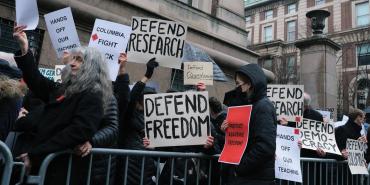
Our unions together represent the largest and most powerful force of faculty and staff in America’s colleges, universities, and community colleges. These campuses are where students go to gain knowledge and advance their lives and where breakthroughs that benefit humankind are discovered. These campuses are also cultural and economic hubs that enliven and enrich the communities around them. By any measure, American higher education is an essential public good. But after more than a half century of disinvestment and ideological attacks, it is under even more ferocious assault from forces seeking to weaponize political power to control how these institutions operate and even what can be taught.
President Donald Trump has declared war on higher education. His administration has cut or withheld billions in federal grant funding,1 arrested student activists,2 targeted diversity initiatives,3 and sought to undermine academic freedom and university independence by tying funding and preferential treatment to adherence to a coercive compact.4
These attacks on higher education threaten instructors’ freedom to teach, students’ freedom to learn, and the foundations that have made America a global leader in research, innovation, and democratic governance. We must understand what is at stake, how we arrived at this moment, and what we must do to protect the independence of institutions of higher education and the right of all students to learn. In this moment of profound crisis, we must not only defend our institutions from sustained political and economic attacks, but advance our vision of what higher education can and must be: a democratic, accessible, and transformative public good.
Our colleges and universities benefit not just individual students, but society as a whole, our democracy, local communities, and the broader economy. Colleges and universities serve multiple essential functions that no other institutions can replicate.
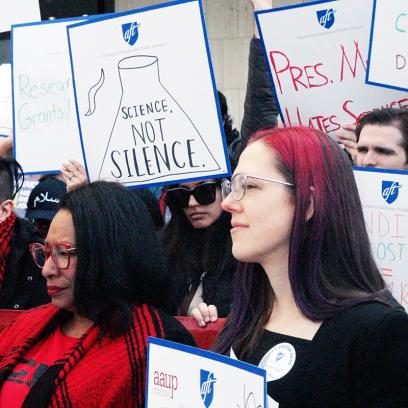
Research and innovation: America’s colleges and universities are drivers of discovery and innovation. Federal funding for university research—totaling $60 billion in fiscal year 20235—has produced breakthroughs that have transformed human life. From the development of COVID-19 vaccines6 to advances in cancer treatment,7 and from artificial intelligence8 to clean energy technologies,9 university researchers have been at the forefront of scientific progress. Universities perform 48 percent of all basic research in the United States, laying the groundwork for innovations that can then be broadly disseminated.10
These institutions have contributed to virtually every major medical breakthrough of the modern era. Research at Harvard Medical School alone led to the development of the smallpox vaccine, anesthesia, insulin, and pioneering work in genetics and cancer treatment.11 Recent university research has yielded treatments for Alzheimer’s disease12 and rare cancers,13 and stem cell therapies14 that were once thought impossible. From 2020 to 2024, universities contributed patents underpinning 50 percent of the drugs approved by the Food and Drug Administration.15
Complex, costly, and protracted work such as this is made possible with the substantial and sustained financial support that only the federal government can provide.
But the Trump administration is deliberately undermining America’s world leadership in science, technology, and innovation. It has slashed billions from the National Institutes of Health,16 the Centers for Disease Control and Prevention,17 and other agencies,18 dismantling the greatest biomedical research infrastructure in the world, bar none. As these budgets are cut and staff are fired, fewer grants are being made to university researchers, and existing grants have been stopped.
The funding cuts and freezes ordered by the Trump administration set us backward, toward an era of less innovation, fewer cures, and a shrinking economy. They result in very real harm to the public—to all of us.
Economic impact: Higher education has economic benefits both for graduates and for the greater society. Students who have completed any level of college generate an estimated $73.4 billion in additional annual earnings relative to those with only a high school education.19 These earnings ripple through local economies, supporting businesses, generating tax revenue, and reducing expenditures on public health, criminal justice, and public assistance programs.
Whether a community college or a four-year university, institutions of higher education anchor communities, often serving as the largest employer in the region.20 Businesses are built around them. Colleges and universities expand opportunities for students and are engines of our local and national economies. States’ public higher education systems also often run hospitals that are major providers of healthcare for local residents and of training for the next generation of clinicians, and our state regional universities—many of which started as “normal schools”—train the educators who teach preK–12.
The State University of New York (SUNY) system is the largest system of public colleges and universities in the country. For every $1 the state of New York invests in SUNY, the SUNY system returns $8.67 to the state in terms of economic growth.21 This pattern repeats across the country. Higher education institutions in Washington, DC, contribute more than $15 billion to the local economy and employ more than 100,000 workers.22 Community colleges in Southwest Virginia collectively benefit regional economic growth by making education accessible and affordable while preparing students for higher-paying jobs.23 Historically Black colleges and universities generate $16.5 billion in economic impact across local and regional economies, generating more than 136,000 jobs and preparing graduates to earn more than $1 million in additional income throughout their working lives.24
Democratic vitality: Higher education serves as a crucial bulwark for democracy. Research shows that the link between increased levels of higher education (particularly studying liberal arts) and decreased levels of authoritarian attitudes is particularly strong in the United States. Education promotes independent thought, respect for diversity, and rigorous assessment of evidence—competencies essential for democratic citizenship and for countering unquestioning deference to authority.25
As one of us (Weingarten) wrote in Why Fascists Fear Teachers,* and as both of us frequently argue, authoritarians fear a well-educated citizenry. They fear what educators do—the teaching of critical thinking, of honest history, of pluralism—because their brand of greed, power, and privilege cannot survive in a democracy of diverse, educated citizens. An educated public is essential to a free and fair America. Educators are under siege not for anything we do wrong, but for all the things we do right.
A History of Disinvestment Rooted in Backlash
The current crisis in higher education did not emerge overnight or as a result of the Trump administration’s assaults, although those have exacerbated the crisis. It is the culmination of decades of systematic disinvestment and political attacks that began as backlash to the civil rights movement and campus activism of the 1960s.26
As student bodies started to become more diverse in the 1960s, and as students and faculty demanded reforms in admissions policies, faculty representation, and the development of race-conscious policies, a powerful backlash coalesced. Conservative politicians and business leaders viewed demands by civil rights activists, educators, and students for greater access to higher education as threats to the existing social and economic order.
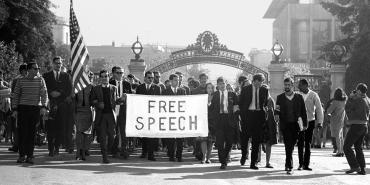
Ronald Reagan’s successful 1966 gubernatorial campaign in California explicitly targeted the Berkeley Free Speech Movement. Politicians across the country followed suit, enacting punitive measures against student activists. The financial sanctions imposed on public higher education were devastating and long-lasting, with state legislatures cutting college and university budgets even as enrollments grew, beginning a pattern of austerity that persists today.
Ellen Schrecker, a professor emerita of American history at Yeshiva University and a longtime AAUP leader, documents this troubling development in her book The Lost Promise: American Universities in the 1960s.27 The promise of free or nearly free access to public higher education gradually disappeared as a result of this backlash. The neoliberal restructuring of higher education that began in the 1970s transformed colleges and universities from institutions prioritizing education as a public good into entities forced to operate like businesses.
A pivotal moment came in 1971 when Lewis F. Powell Jr., shortly before his nomination to the Supreme Court, wrote a confidential memo to the US Chamber of Commerce titled “Attack on American Free Enterprise System,” in which he crafted a blueprint for corporate political and economic dominance. Powell identified college campuses as “the single most dynamic source” of attacks on the American economic system and called for a comprehensive, coordinated counteroffensive by the business community.28
The Powell memo laid out a strategic plan that included developing scholars to be placed on college campuses, demanding “balance” on college faculties, influencing curriculum, and ensuring that think tanks and media outlets promoted pro-corporate perspectives. Inspired by Powell, in 1978 former Treasury Secretary William E. Simon explicitly called for using economic pressure to reshape higher education, suggesting that businesses should “cease the mindless subsidizing of colleges and universities whose departments of economics, government, politics, and history are hostile to capitalism.”29
In the decade following its publication, the number of corporations with public affairs offices in Washington grew from 100 to more than 500, registered lobbyists increased from 175 to nearly 2,500, and corporate political action committees multiplied from under 300 to more than 1,200. Conservative think tanks proliferated, lavishly funded to produce research attacking higher education as a public good and supporting free-market ideology.30
Today, the Trump administration is following a modern-day successor to the Powell memo’s blueprint to capture higher education for ideological purposes: the Heritage Foundation’s Mandate for Leadership, commonly called “Project 2025.”
Project 2025 is a 900-page document meant to serve as a road map for a far-right presidential administration. The Trump administration swiftly began enacting its sweeping policy proposals, which are designed to give anti-democratic politicians, judges, and oligarchs more control over Americans’ lives. Among its sweeping provisions is a radical plan to transform American colleges and universities by cutting funding, stifling ideas, silencing debate, and destroying autonomy.
Project 2025 details the intent to roll back decades of progress on access to higher education, eliminate protections for LGBTQIA+ students and sexual assault survivors, privatize student loans, end loan forgiveness, attack programs like TRIO and GEAR UP that provide a real pathway to a college education for low-income students, and, as we are seeing, abolish the US Department of Education.
The document baselessly claims that institutions of higher education are “hostile to free expression, open academic inquiry, and American exceptionalism.”31 That is a central myth promoted by those attacking higher education: that colleges and universities are centers of indoctrination rather than education. This claim inverts reality.
Education Is the Antithesis of Indoctrination
Contrary to claims by some that universities are bastions of indoctrination, the goal of education is not to get all students on the same page politically or ideologically.32 It is to develop their ability to reason through complex problems, to separate fact from fiction and information from disinformation, to apply reasoning, and to form their own opinions. Critical thinking is the most important muscle in the exercise of democracy.
Higher education prioritizes students’ freedom to learn by creating open environments for inquiry and engagement. Students learn to evaluate evidence, consider multiple perspectives, engage in civil dialogue, and form independent judgments. We want ideological diversity on campuses and an open environment that challenges assumptions, beliefs, and ideas—without it, the intellectual environment dies.
Campuses should be places of free speech, with the exception of speech not protected by the First Amendment, such as defamation, incitement, and true threats. The proper response to controversial or offensive speech is not censorship but more speech—open and vigorous contestation of ideas through reasoned argument and evidence. Universities and colleges fulfill their mission not by shielding students from challenging concepts but by equipping them to grapple with complexity, ambiguity, and disagreement.
Our campuses must be places where all are safe to learn, speak, and question. Protecting free expression and ensuring safety are not competing goals, they are inseparable: Students need to feel safe enough to speak freely. And they are especially vital given the growing divisions in the United States and the efforts to limit constitutionally protected freedoms since the October 7, 2023, Hamas attacks.33
We will continue to combat antisemitism on our campuses and in our society because all students and staff must feel and be safe and welcome on campus. We are especially concerned, however, about the Trump administration’s cynical weaponization of antisemitism as a pretext for censoring scientific research as well as targeting immigrants and free speech on campuses. Instead of addressing the legitimate concerns of students, faculty, and staff about antisemitism, the Trump administration is exploiting the issue to attack colleges and universities and to undermine democratic norms and rights.34
The Corporatization of Higher Education
The shift away from viewing higher education as a public good has had devastating consequences for how colleges and universities operate. As government appropriations dwindled, institutions increasingly turned to raising revenue through tuition, private donors, and federal and corporate research grants. Between 2003 and 2020, state and federal appropriations fell from 68.5 percent to just 56.1 percent of total revenue for public universities.35
This financial pressure led to the erosion of shared governance—the principle that faculty, administrators, and boards should work together on institutional decisions. As colleges and universities adopted top-down managerial practices borrowed from business, they sidelined faculty input in favor of institutional efficiency. The traditional role of faculty in determining curriculum, hiring, and institutional priorities gave way to a corporate model focused on cost-cutting and revenue generation—often without regard to the impact on students’ opportunities to learn.36
Decades of public disinvestment in our public colleges and universities has led to higher tuition and fees for students, cuts in academic programs, institutional closures, and the decline of stable, full-time positions in academia.
Average tuition at public four-year universities has increased by 213 percent since the late 1980s.37 Meanwhile, average student loan debt (for all students, not just those at public colleges) rose from $27,260 in 2007 to $37,850 in 2024 (with both figures in 2024 dollars).38 For many students, particularly those from low-income families and communities of color, this debt burden is a crushing obstacle to economic mobility and wealth-building.39
Simultaneously, the academic workforce has been radically changed. Forty years ago, 70 percent of academic employees were tenured or tenure-track. Today, that figure has flipped: 68 percent of faculty are contingent workers who are not eligible for tenure and 48 percent hold part-time positions.40 Academics increasingly are joining the ranks of gig workers and temps, working part time for low pay, often without benefits or job security. This lack of job security makes colleagues in contingent positions especially vulnerable in this current environment of censorship and attacks on freedom to teach.
More than one-quarter of adjunct faculty respondents in an AFT survey reported earning less than $26,500 annually, and only 22.5 percent reported having contracts providing continuous employment.41 Many adjuncts teach at multiple institutions simultaneously, rushing between campuses with little time for the engagement with students that effective teaching requires.
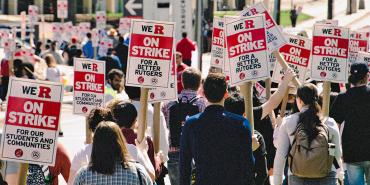
One of us (Wolfson), as president of the Rutgers AAUP-AFT local in 2023, helped lead the first strike of academic workers at Rutgers in the institution’s then-257-year history. Our strike brought together 9,000 workers across three unions representing faculty, graduate workers, postdocs, librarians, healthcare workers, and counselors. We won more control over our work, contractual rights around academic freedom, and raises of 14 to 44 percent over four years, as well as a $600,000 fund to support housing for workers living near the university.42 Key to our demands were the needs of the more vulnerable parts of our unit—the adjunct faculty and graduate workers. In an important victory, we won job security for full-time nontenure-track faculty, adjunct faculty, postdocs, and grad workers.
How did we do this? By rallying the support of the community and reminding the administration that a university is more than a business.
The Trump Administration’s Authoritarian Assault
From Project 2025 to the broadsides on higher education from both Trump and Vice President JD Vance, the administration’s hostility toward higher education has not been whispered but blared.
Trump has declared that “our colleges [have] become dominated by Marxist maniacs and lunatics” and vowed to “get this anti-American insanity out of our institutions once and for all.”43 We cannot help but wonder how the “radical Left” that Trump rails about manages to indoctrinate students in their physics labs, accounting courses, and Chaucer lectures. Even in courses about the 20th-century rise of fascism, students are expected to think for themselves and to debate each other (only a fascist would tell them what to think).
With the ascension of Vance to the vice presidency, far-right forces have succeeded in elevating an extremist who vows to “aggressively attack universities in this country”44 to within striking distance of their goal: the annihilation of American higher education as we know it.
Vance’s labeling of professors as “the enemy” and his praise of Hungarian dictator Viktor Orbán’s seizure of state universities as “the closest conservatives have ever gotten to successfully dealing with left-wing domination of universities” are unambiguous.45 This administration aims to take control of higher education and bend it to their will.
The Trump administration set out almost immediately to freeze or threaten billions in federal funding to coerce universities into compliance with ideological demands that violate institutional autonomy or the First Amendment. By April 2025, the administration had frozen or paused federal funding to numerous universities, including more than $400 million to Columbia University, $2.3 billion to Harvard, $1 billion to Cornell, and $790 million to Northwestern.46 The administration justified these actions by claiming universities had not adequately addressed antisemitism, but federal judges have found that the government was actually engaged in ideologically motivated retaliation against institutions that refused to surrender their independence.47
Trump’s so-called Compact for Academic Excellence in Higher Education is essentially a loyalty oath.48 The compact would force colleges and universities to adopt Trump’s priorities in exchange for favorable treatment, including access to federal funding. Trump’s corrupt bribery attempt would usher in a new draconian era of thought policing in American higher education, damage our capacity for technological innovation, and assault our very democracy. No amount of federal inducement is worth surrendering the freedom to question, explore, and dissent.
Trump’s compact is not just wrong, it’s unconstitutional. It violates the First Amendment by forcing universities to surrender their right of free speech and academic freedom in exchange for federal funds. It risks America’s world leadership in science, technology, innovation, and healthcare, creating opportunities for our competitors and our enemies to take the lead. It sets us backward toward an era of less innovation, fewer cures for diseases, and a shrinking economy.
The AAUP and AFT, as well as others, have sued to halt the administration’s abuses of power and illegal actions targeting higher education. We have prevailed in several important cases.
The Trump administration has systematically targeted diversity, equity, and inclusion initiatives across higher education. On the first full day of his second administration, Trump issued an executive order requiring all federal agencies to end what it describes as “illegal discrimination” and directing agencies to identify potential investigations of institutions with endowments over $1 billion.49 The US Department of Education responded by sending “Dear Colleague” memos to colleges and universities ordering them to end all “race-based decision-making” or face penalties, including loss of federal funding.50
In August 2025, federal Judge Stephanie Gallagher agreed with a lawsuit filed by the AFT that the government was enforcing “unclear and highly subjective” restrictions that forced educators to “choose between chilling their constitutionally protected speech and association or risk losing federal funds and being subject to prosecution.”51 And that victory was affirmed on appeal and became final in January 2026 when the Trump administration withdrew its appeal.
In September 2025, a federal district court issued a scathing decision blocking the Trump administration from withholding federal funds from Harvard. Judge Allison D. Burroughs found that the administration “impermissibly imposed unconstitutional conditions on Harvard’s receipt of federal funds”52 and engaged in First Amendment retaliation after Harvard refused to comply with demands that would violate its constitutional rights.
And in the AAUP v. Rubio case, the AAUP took on the Trump administration’s attempt to deny international students and scholars First Amendment rights and to use participation in constitutionally protected speech as a pretext to purge these academics from the country. In late September, Judge William G. Young found that the Trump administration had violated these individuals’ constitutional rights, writing that, “This case—perhaps the most important ever to fall within the jurisdiction of this district court—squarely presents the issue whether non-citizens lawfully present here in [the] United States actually have the same free speech rights as the rest of us. The Court answers this Constitutional question unequivocally ‘yes, they do.’ ‘No law’ means ‘no law.’ The First Amendment does not draw President Trump’s invidious distinction and it is not to be found in our history or jurisprudence.”53
And in November, the AAUP and AFT were granted a preliminary injunction that will stop the Trump-Vance administration’s attempt to unlawfully stifle free speech and academic freedom across the University of California system’s 10 campuses and medical centers. The judge wrote that our wall-to-wall labor union lawsuit submitted “overwhelming evidence” that the administration has engaged in a concerted campaign to purge certain viewpoints in violation of the First Amendment.54
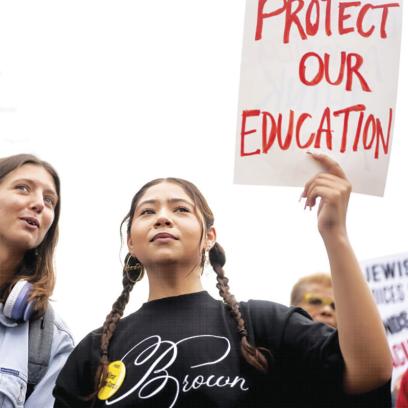
But our most successful response to the Trump compact has been the organizing work undertaken by our members and the students at Brown, Dartmouth, the University of Virginia, Vanderbilt, the University of Texas at Austin, MIT, the University of Pennsylvania, the University of Southern California, and the University of Arizona. Their successful organizing and protesting—coupled with our unions’ national petition—created the momentum for seven of the nine administrations to reject the compact.55 None of the original nine have signed on, and even after Trump opened the compact up to all colleges and universities, we are seeing very little appetite from institutions of higher education to sign on.
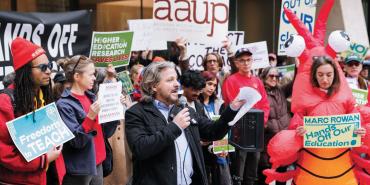
We must continue to forge and strengthen alliances with students at our universities and colleges because the fight to save higher education is a fight for their futures. They should have a right to higher education that is debt-free and that provides them with education and skills they need not only to thrive but also to meaningfully engage in their communities. That is why we joined with student groups on November 7 for a day of action, with our members participating in rallies, teach-ins, and protests in over 100 locations nationwide, including a large, multi-union rally outside the Apollo Global Management headquarters in New York City to protest CEO Marc Rowan’s involvement in the drafting of the Trump compact for higher education and protests outside Senator Dave McCormick’s offices across Pennsylvania to call for more federal funding for higher education.56 And that is why we continue to work in coalition with student groups to push back on Trump’s agenda for higher education and to push for higher education that truly serves our students and our communities.
The Assaults on Academic Freedom and Free Speech
Historian Ellen Schrecker observes that the crackdown today within higher education is “worse than McCarthyism—much worse.” Then, individual academics were scrutinized and fired for Communist ties. But today, she notes, the country is experiencing a “frontal attack on everything that has to do with universities and colleges.”57
The Trump administration is demanding institutional neutrality all the way down in clear violation of constitutional rights. It follows authoritarian regimes across the world,† restricting speech, abducting our students in broad daylight for writing editorials they don’t like, and outlawing protests on our campuses,58 which we believe is a prelude to trying to crush dissent in society writ large.
Even before the burst of terminations related to commentary on the assassination of conservative activist Charlie Kirk59—political violence that we as a union have unequivocally condemned—faculty members reported being increasingly afraid to express political views or engage with controversial topics, knowing that a single social media post, even on their personal accounts, could cost them their jobs and livelihoods. Surveys show that more than half of faculty report self-censoring in response to perceived threats to their academic freedom.60
The University of Chicago’s “Chicago Principles” on free expression make clear that “it is not the proper role of the University to attempt to shield individuals from ideas and opinions they find unwelcome, disagreeable, or even deeply offensive.”61 Indeed, a core purpose of higher education is to provide a forum to wrestle with difficult ideas and engage with people across differences.
The September 2025 assassination of Kirk led to an unprecedented wave of faculty and staff terminations that has further intensified the climate of fear in higher education. In the month following that terrible event, at least 40 faculty were fired or threatened with termination for comments related to the killing—half the number of faculty who were fired during the entire McCarthy era.62
The Trump administration is putting the vise on wholesale institutions—demanding changes to how departments operate and ordering universities to eliminate departments that it says create violence against conservative ideology.
In Orwellian doublespeak, they are using fear, misinformation, and intimidation to turn colleges and universities into what the far right has for years falsely accused them of being: indoctrination centers.
The Struggle for Higher Education’s Soul and Survival
The convergence of decades of disinvestment, corporatization, attacks on shared governance, the affordability crisis, and now an openly authoritarian assault from the federal government poses grave threats to higher education in America.
In this moment of profound crisis, we have a responsibility—not only to defend our institutions from sustained political and economic attacks, but to advance a bold, collective vision of higher education as a democratic, accessible, and transformative public good.
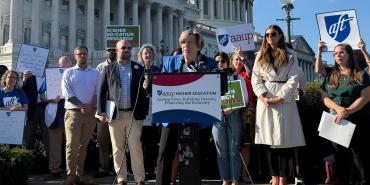
That is the purpose of the joint higher education campaign launched in September 2025 by the AAUP and AFT: Saving Lives, Building Futures, Powering the Economy. We want workers on our campuses to have dignity and security. We want to expand opportunity, make college more affordable for anyone who wants to pursue postsecondary education, and end crushing student debt. We want to ensure that all those who work in our colleges and universities have jobs that provide them with dignity and economic security. And we want to uphold academic freedom and students’ freedom to learn.
It is a simple proposition: Any person who wants to avail themselves of postsecondary education should be able to do so—in a manner that is affordable and accessible.
That is part of the American dream—and America can achieve its role in the world as that engine of opportunity and innovation and hope and freedom when its universities are muscular, dynamic campuses full of vibrancy and aspiration.
To bring this to fruition, higher education faculty and staff, students, parents, unions, businesses, policymakers, and others with an interest in not just preserving but strengthening and improving higher education must unite. We must forge a political force that can respond to the threats, offer a counter vision, and fight for a policy agenda that enacts that vision.
We must become a social and political force with footholds on every campus, in every state, and at the national level to resist authoritarian control and to advocate for reinvestment in our colleges and universities so that they are truly a public good.
We must tell the truth about higher education—acknowledging genuine problems that need addressing while rejecting false narratives designed to justify ideological control. And we must refuse to choose between academic freedom and safety, between excellence and equity, between free inquiry and community. These are false choices designed to divide us. The path forward requires embracing all of these values, recognizing that they are complementary and mutually reinforcing.
We write this not only as a warning but as a vision of what can be. The fight for higher education in America is a fight for the common good, for democracy, and for the American dream.
Randi Weingarten is the president of the AFT and the author of Why Fascists Fear Teachers. Prior to her election in 2008, she served for 11 years as president of the United Federation of Teachers, AFT Local 2. A teacher of history at Clara Barton High School in Brooklyn from 1991 to 1997, Weingarten helped her students win several state and national awards debating constitutional issues. Widely recognized as a champion of public schools and a better life for all people, her commendations include being named to Washingtonian’s 2023 Most Influential People in Washington and City & State New York’s 2021 New York City Labor Power 100. Todd Wolfson is the president of the American Association of University Professors (AAUP) and has been in leadership of Rutgers AAUP-AFT. Wolfson is an associate professor in the Department of Journalism and Media Studies at Rutgers University and codirector of the Media, Inequality and Change Center; his most recent book is The Gig Economy: Workers and Media in the Age of Convergence. Previously, Wolfson worked as a community and labor organizer in Philadelphia.
*To read an excerpt, see “Why Do Fascists Fear Teachers?” in the Fall 2025 issue of American Educator. (return to article)
†For more on how the Trump administration is following the lead of other authoritarian rulers, see “The Trump Administration Is Trying to Wreck Our Democracy” in the Fall 2025 issue of American Educator. (return to article)
Endnotes
1. G. Bedekovics and W. Ragland, “Mapping Federal Funding Cuts to U.S. Colleges and Universities,” Center for American Progress, July 23, 2025, americanprogress.org/article/mapping-federal-funding-cuts-to-us-colleges-and-universities.
2. N. Raymond and L. Cohen, “Trump Targeting of Pro-Palestinian Campus Activists for Deportation Is Unlawful, US Judge Rules,” Reuters, September 30, 2025, reuters.com/world/us/trump-backed-targeting-pro-palestinian-campus-activists-deportation-is-unlawful-2025-09-30.
3. Associated Press, “Judge Strikes Down Trump Administration Guidance Against DEI Programs at Schools,” National Public Radio, August 15, 2025, npr.org/2025/08/15/nx-s1-5503319/judge-strump-dei-programs-schools.
4. A. Blinder, “How Universities Are Responding to Trump,” New York Times, December 1, 2025, nytimes.com/article/trump-university-college.html.
5. P. Forrest, R. Judd, and S. Pittman, “Higher Education’s Uncertain Fiscal Future,” Pew Research Center, November 12, 2025, pew.org/en/research-and-analysis/articles/2025/11/12/higher-educations-uncertain-fiscal-future.
6. Mayo Clinic, “COVID-19 and Related Vaccine Development and Research: History of COVID-19: Outbreaks and Vaccine Timeline,” mayoclinic.org/diseases-conditions/history-disease-outbreaks-vaccine-timeline/covid-19.
7. Cancer Research Institute, “The 2024 Impact Report of the Cancer Research Institute,” August 9, 2024, cancerresearch.org/media-room/the-2024-impact-report-of-the-cancer-research-institute.
8. A. Zewe, “Explained: Generative AI,” MIT News, November 9, 2023, news.mit.edu/2023/explained-generative-ai-1109.
9. National Energy Technology Laboratory, “U.S. Department of Energy Invests $17 Million for University-Led Projects to Advance Decarbonization and Net-Zero Greenhouse Gas Emissions,” US Department of Energy, January 10, 2024, netl.doe.gov/node/13236.
10. Aspen Economic Strategy Group, “Seven Recent Developments in US Science Funding,” Aspen Institute, January 9, 2023, economicstrategygroup.org/publication/seven-recent-developments.
11. Harvard Medical School, “Timeline of Discovery,” hms.harvard.edu/about-hms/history-hms/timeline-discovery.
12. L. Gadye, “Do These Two Cancer Drugs Have What It Takes to Beat Alzheimer’s?,” University of California San Francisco, July 21, 2025, ucsf.edu/news/2025/07/430386/do-these-two-cancer-drugs-have-what-it-takes-beat-alzheimers.
13. N. Boeck, “Showcasing New Strides in Rare Cancer Research,” Fred Hutch Cancer Center, Hutch News Stories, October 31, 2025, fredhutch.org/en/news/center-news/2025/10/showcasing-new-strides-rare-cancer-research.html.
14. W. Parry, “Developing the Cell-Based Therapies of the Future,” University of Miami Miller School of Medicine, November 11, 2024, news.med.miami.edu/developing-the-cell-based-therapies-of-the-future.
15. K. Gardner and M. Kinch, “We Set Out to Quantify U.S. Academic Contributions to Medicines. The Results Stunned Even Us,” Stat, June 6, 2025, statnews.com/2025/06/06/us-universities-fda-approved-drugs-research-patents-orange-book.
16. M. Kozlov and C. Ryan, “How Trump 2.0 Is Slashing NIH-Backed Research—in Charts,” Nature, April 11, 2025, nature.com/articles/d41586-025-01099-8; and D. Cutler and E. Glaeser, “Cutting the NIH—the $8 Trillion Health Care Catastrophe,” JAMA Health Forum 6, no. 5 (May 29, 2025): e252791, jamanetwork.com/journals/jama-health-forum/fullarticle/2834949.
17. M. Goldman and S. Moreno, “Trump Admin Cancels Over $12B in Health Care Grants,” Axios, March 27, 2025, axios.com/2025/03/27/trump-admin-cancels-state-health-care-grants.
18. A. Winnike, “Updates to HHS Restructuring and Funding Cuts: Impact on State and Local Public Health,” Network for Public Health Law, April 3, 2025, networkforphl.org/news-insights/updates-to-hhs-restructuring-and-funding-cuts-impact-on-state-and-local-public-health.
19. K. Dancy, “Higher Education’s Economic Benefits to Communities,” Institute for Higher Education Policy, October 8, 2025, ihep.org/higher-educations-economic-benefits-to-communities.
20. World Population Review, “Largest Employer by State 2025,” worldpopulationreview.com/state-rankings/largest-employer-by-state; and R. Allen, “Universities Are Job Centers for the Entire Country,” College Towns (blog), April 21, 2025, collegetowns.org/p/universities-are-job-centers-for.
21. B. Backstrom and P. Schumacher, The Economic Impact of the State University of New York: Academic Year 2020 (Rockefeller Institute of Government, February 2024), rockinst.org/wp-content/uploads/2024/02/SUNY-Economic-Report-AY2020.pdf.
22. Consortium of Universities of the Washington Metropolitan Area, “Investing in the Future: Great Cities Have Great Colleges and Universities. Higher Education Institutions Power the Economy of Washington, DC and Its Surrounding Region,” February 2025, consortium.org/wp-content/uploads/2025/02/Investing-in-the-Future.-Economic-Contributions-of-Consortium-Members.pdf.
23. Wytheville Community College, “SWVA Community Colleges Participate in Economic Impact Studies,” February 20, 2024, wcc.vccs.edu/news/swva-community-colleges-participate-economic-impact-studies.
24. United Negro College Fund, “Transforming Futures: The Economic Engine of HBCUs,” 2024, uncf.org/wp-content/uploads/Final_UNCF_2024-HBCUEconImpactReport_National.pdf.
25. A. Carnevale et al., The Role of Education in Taming Authoritarian Attitudes (Georgetown University, Center on Education and the Workforce, McCourt School of Public Policy, 2020), cew.georgetown.edu/wp-content/uploads/The-Role-of-Education-in-Taming-Authoritarian-Attitudes-Full-Report.pdf.
26. Northwestern University, “Research Suggests Attacks on Higher Ed Part of a ‘Political Playbook’ Since the Civil Rights Moment,” Northwestern Now, April 4, 2025, news.northwestern.edu/stories/2025/04/research-suggests-attacks-on-higher-ed-part-of-a-political-playbook-since-the-civil-rights-movement?fj=1; and C. Hedges, “Americans Were Once Promised Affordable College for All. What Happened?,” Real News Network, May 5, 2023, therealnews.com/americans-were-once-promised-affordable-college-for-all-what-happened.
27. E. Schrecker, The Lost Promise: American Universities in the 1960s (University of Chicago Press, 2021), ellenschrecker.com/thelostpromise.
28. L. Powell, “The Powell Memorandum: Attack on American Free Enterprise System,” Washington and Lee University School of Law, Scholarly Commons, scholarlycommons.law.wlu.edu/powellmemo/1.
29. J. Tobin, “Treasurer’s Report,” New York Times, June 11, 1978, nytimes.com/1978/06/11/archives/treasurers-report-report.html; and L. Stamato, “The Launch of the Long Game,” Inside Higher Ed, May 9, 2023, insidehighered.com/opinion/views/2023/05/09/powell-memo-helped-launch-attacks-higher-ed-opinion.
30. J. Hacker and P. Pierson, Winner-Take-All Politics: How Washington Made the Rich Richer—and Turned Its Back on the Middle Class (Simon & Schuster, 2010); and J. Pilaar, “The Making of the Supreme Court Bar: How Business Created a Solicitor General for the Private Sector,” Michigan Law Review, December 2018, michiganlawreview.org/the-making-of-the-supreme-court-bar.
31. Heritage Foundation, Mandate for Leadership: The Conservative Promise (2023), static.heritage.org/project2025/2025_MandateForLeadership_FULL.pdf.
32. S. Kammer, “The ‘Intellectual Diversity’ Crisis That Isn’t: Liberal Faculties, Conservative Victims, and the Cynical Effort to Undermine Higher Education for Political Gain,” Quinnipiac Law Review 39, no. 149 (April 7, 2021): 149–224, quinnipiaclawjournals.com/4a5661/globalassets/sub-sites/law-journals/media/documents/law-review/kammer_final.pdf.
33. S. Ashar, “The Assault on Campus Protests,” Academe 111 (Spring 2025), aaup.org/academe/issues/spring-2025/assault-campus-protests.
34. R. Weingarten, “Protecting Academic Freedom and Our Democracy: The Role of Faculty Unions,” American Educator 49, no. 3 (Fall 2025): 48–51.
35. R. Martire and A. Flanagan, Illinois’ Continued Disinvestment in Higher Education (Center for Tax and Budget Accountability, November 9, 2021), ctbaonline.org/reports/illinois%E2%80%99-continued-disinvestment-higher-education.
36. A. Kezar, “Why the Top-Down Governance Structures of Higher Education Need Revitalizing,” USC Rossier, April 27, 2020, rossier.usc.edu/news-insights/news/why-top-down-governance-structures-higher-education-need-revitalizing.
37. E. Martin, “Here’s How Much More Expensive It Is for You to Go to College Than It Was for Your Parents,” CNBC, November 29, 2017, cnbc.com/2017/11/29/how-much-college-tuition-has-increased-from-1988-to-2018.html.
38. M. Hanson, “Average Student Loan Debt by Year,” Education Data Initiative, August 16, 2024, educationdata.org/average-student-loan-debt-by-year.
39. Martire and Flanagan, Illinois’ Continued Disinvestment.
40. G. Colby, “Data Snapshot: Tenure and Contingency in US Higher Education,” Academe 109, no. 1 (Spring 2023), aaup.org/academe/issues/spring-2023/data-snapshot-tenure-and-contingency-us-higher-education.
41. AFT, “New AFT Report: Adjunct Faculty Remain Underpaid, Underappreciated,” October 26, 2023, aft.org/news/new-aft-report-adjunct-faculty-remain-underpaid-underappreciated.
42. R. Maton, “Lessons from the Rutgers Strike: Reflecting Six Months Later,” Spectre, January 12, 2024, spectrejournal.com/lessons-from-the-rutgers-strike; and Rutgers-New Brunswick School of Communication and Information, “Todd Wolfson Elected President of the American Association of University Professors,” October 31, 2024, comminfo.rutgers.edu/news/todd-wolfson-elected-president-american-association-university-professors.
43. D. Trump, “Agenda47: Protecting Students from the Radical Left and Marxist Maniacs Infecting Educational Institutions,” DonaldJTrump.com, July 17, 2023, donaldjtrump.com/agenda47/agenda47-protecting-students-from-the-radical-left-and-marxist-maniacs-infecting-educational-institutions.
44. T. Wolfson, “Professors Are Not the Enemy. Fascists Are,” American Association of University Professors, August 8, 2024, aaup.org/news/professors-are-not-enemy-fascists-are.
45. G. Scheiring, “I Watched Orbán Destroy Hungary’s Democracy. Here’s My Advice for the Trump Era,” Politico, November 23, 2024, politico.com/news/magazine/2024/11/23/trump-autocrat-elections-00191281.
46. Reuters, “Columbia University Caves to Demands to Restore $400m from Trump Administration,” The Guardian, March 21, 2025, theguardian.com/us-news/2025/mar/21/columbia-university-funding-trump-demands; B. Brooks and I. Shakil, “Harvard Rejects Trump Demands, Gets Hit by $2.3 Billion Funding Freeze,” Reuters, April 15, 2025, reuters.com/world/us/harvard-will-fight-trump-administration-demands-over-funding-2025-04-14; and M. Bender and S. Stolberg, “Trump Administration Freezes $1 Billion for Cornell and $790 Million for Northwestern, Officials Say,” New York Times, April 8, 2025, nytimes.com/2025/04/08/us/politics/cornell-northwestern-university-funds-trump.html.
47. G. Morrison and R. Power, “Federal Court Blocks Trump Administration’s Freeze of Grants to Harvard University: Implications for First Amendment and Title VI Enforcement,” Buchanan Ingersoll & Rooney PC, September 12, 2025, bipc.com/federal-court-blocks-trump-administration%E2%80%99s-freeze-of-grants-to-harvard-university-implications-for-first-amendment-and-title-vi-enforcement.
48. A. Blinder, “All but 2 Universities Decline a Trump Offer of Preferential Funding,” New York Times, October 20, 2025, nytimes.com/2025/10/20/us/politics/universities-funding-compact.html.
49. White House, “Ending Illegal Discrimination and Restoring Merit-Based Opportunity,” January 21, 2025, whitehouse.gov/presidential-actions/2025/01/ending-illegal-discrimination-and-restoring-merit-based-opportunity.
50. C. Trainor, “Dear Colleague letter,” US Department of Education, Office for Civil Rights, February 14, 2025, ed.gov/media/document/dear-colleague-letter-sffa-v-harvard-109506.pdf.
51. Associated Press, “Judge Strikes Down Trump Administration Guidance Against DEI Programs at Schools,” National Public Radio, August 15, 2025, npr.org/2025/08/15/nx-s1-5503319/judge-strump-dei-programs-schools.
52. Morrison and Power, “Federal Court Blocks.”
53. American Association of University Professors, “Court Rules in AAUP v Rubio: Trump Admin Violated First Amendment,” September 30, 2025, aaup.org/news/court-rules-aaup-v-rubio-trump-admin-violated-first-amendment.
54. American Association of University Professors, “Win in AAUP v. Trump: Court Blocks Attacks on University of California System,” November 15, 2025, aaup.org/news/win-aaup-v-trump-court-blocks-attacks-university-california-system.
55. Blinder, “All but 2 Universities.”
56. V. Myers, “We Rise Up to Save Higher Education,” AFT, November 13, 2025, aft.org/news/we-rise-save-higher-education.
57. Q. Jurecic, “The Third Red Scare,” The Atlantic, November 10, 2025, theatlantic.com/ideas/2025/11/first-amendment-trump-free-speech-red-scare/684866.
58. A. Johnson, “Trump’s Assault on the First Amendment,” International Bar Association, May 14, 2025, ibanet.org/Trumps-assault-on-the-First-Amendment.
59. E. Whitford, “6 More Faculty, Staff Removed for Kirk Comments,” Inside Higher Ed, September 12, 2025, insidehighered.com/news/faculty-issues/academic-freedom/2025/09/12/6-more-faculty-staff-removed-kirk-comments.
60. R. Quinn, “Watching Their Words: Faculty Say They’re Self-Censoring,” Inside Higher Ed, January 9, 2025, insidehighered.com/news/faculty-issues/academic-freedom/2025/01/09/watching-their-words-us-faculty-say-theyre-self.
61. G. Stone et al., Report of the Committee on Freedom of Expression, University of Chicago, January 2015, provost.uchicago.edu/sites/default/files/documents/reports/FOECommitteeReport.pdf.
62. E. Davis, G. Escott, and C. Murphy, “Employees and Students at These Colleges Have Been Punished for Comments on Charlie Kirk’s Death,” Chronicle of Higher Education, September 22, 2025, chronicle.com/article/employees-and-students-at-these-colleges-have-been-punished-for-comments-on-charlie-kirks-death; and Whitford, “6 More Faculty.”
[Opening photo: Marco Postigo Storel / The New York Times / Redux; Photo of protestors with Science sign: AFT; Historic photo of campus protest: Ron Enfield; Photo, Rutgers strike: Kyle Handojo; Photo, “Protect Our Education”: AP Photo / Noah Berger; Photo: AAUP protest with Wolfson speaking: Courtesy of the AAUP; Photo: Randi speaking at press conference: AFT]