 Member Benefits
 How to Join
 En Espanol
In the classrooms, there are empty desks. On the street corners, there are teachers keeping watch, equipped with whistles and encrypted messaging apps. In the closets, there are stores of donated groceries that teachers will quietly take to students’ homes via circuitous routes and decoy drop-off points to avoid detection.

These are members of Education Minnesota, the AFT’s state affiliate, making their way through a regular school day in Minneapolis–St. Paul. Since the beginning of “Operation Metro Surge”—a December 2025 immigration enforcement operation that brought an estimated 3,000 federal personnel to the Twin Cities—this is what “regular” looks like.
“I never thought I would be trying to keep children safe from the federal government,” says Tracy Byrd, a ninth-grade English teacher at Washburn High School in Minneapolis and Minnesota’s 2024 Teacher of the Year. “Never in my wildest dreams.”
Teachers in five schools stretching from a St. Paul suburb to the heart of Minneapolis say that is exactly what they are doing: volunteering personal time to support students and families navigating fear and disruption. Some describe Immigration and Customs Enforcement agents waiting in front of their schools, following school buses home and flying drones over local neighborhoods. The educators’ efforts, they explain, are in service of restoring the most basic premise for teaching: kids have to feel safe enough to walk through the door.
The tension between teaching and safety is now at the center of a federal lawsuit backed by Education Minnesota and two school districts seeking to block immigration enforcement anywhere near schools absent a judicial warrant or true emergency. Several news outlets havereported multiple incidents of agents interfering near schools: removing a teacher from her car, pulling over school vans transporting kids to school, and tackling people outside a Minneapolis high school and releasing chemical irritants. The Department of Homeland Security states that agents are detaining “the worst of the worst,” but in documented cases, agents have detained people with pending asylum cases, including a 5-year-old child, who were later ordered released by a judge. DHS agents also fatally shot two U.S. citizens, Renée Good and Alex Pretti, during protests over the ICE surge.
Empty desks, unexpected roles
In the wake of Renée Good’s killing, six school districts in the Minneapolis–St. Paul area offered a remote-learning option. Taking attendance, says third-grade teacher Mike Vestal, is now less about actual attendance and more about who is missing—and why.
“I have at least five to six kids gone every day doing online learning because they’re afraid to come to school,” Vestal says. “One of them even emailed me and told me they’re a U.S. citizen, but they’re just too afraid.”
Vestal teaches at Northport Elementary in Brooklyn Center, a suburb of Minneapolis. In January, DHS agents detained a Northport student’s parent at a school bus stop. Vestal happened to be in the office when the student arrived at school in tears, not knowing if her mother would be there when she got home. She was not, Vestal says. He says he doesn’t know where her mother is now.
Since then, attendance has been spotty, he says, and the gaps are more than academic. Empty desks represent families choosing to stay behind locked doors at the expense of jobs, school and even groceries. Vestal and fellow teachers are stepping in outside school hours, delivering supplies and donations so families don’t have to leave the house. One delivery ended with a parent in tears, he says. Another parent kept pointing up at the sky, overwhelmed by relief and gratitude.
But the deliveries are not without risk, Vestal says. Teachers are delivering to apartment complexes that house large numbers of immigrant families. He says federal agents have taken note and station themselves around the complexes, “not looking for anybody. Just looking for somebody.”
So there are protocols. Put your phones in airplane mode. Go in groups. Go quietly.
The protocols extended to a recent field trip to Como Park Zoo & Conservatory, where teachers talked with zoo staff ahead of time about what to do if immigration agents showed up. Had agents been there before, they asked? If agents did show up, is there a private room where kids could shelter in place?
“This is just crazy,” Vestal says. “This is what I’m talking about for a third-grade field trip? Making sure my kids are safe from federal agents? Is this normal now?”
The new normal: Kids in hiding, trauma in real time and double the teaching load
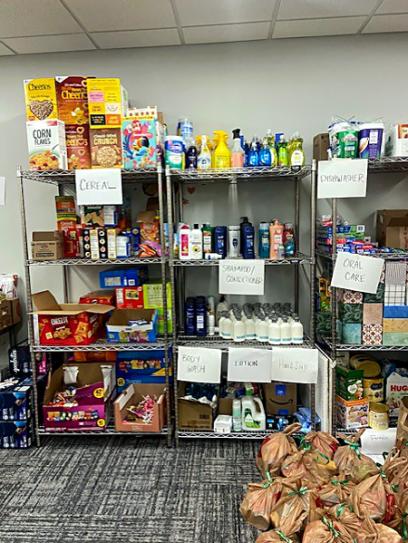
Excessive absences. Teaching schedules turned hybrid overnight. Classrooms stacked with paper towels, macaroni and cheese and donated basics. For high school teachers Amy Mousel-Houston and her husband, Michael Houston, who teach at Tartan High in Oakdale and Harding High in St. Paul, respectively, this is what “normal” looks like now.
About 15 percent of the students on Tartan’s 1,700-student campus took the remote-learning option offered by the district, according to Mousel-Houston. The fear, she says, is not unfounded.
“In January, we noticed ICE agents near the school,” Mousel-Houston says. “They never set foot on campus, but my ninth-graders came into my first hour and said, ‘we just saw ICE apprehend a Hispanic man.’ They were just getting off the school bus, and this is happening in front of their eyes. This extraordinary trauma is just becoming part of their norm.”
The switch to a hybrid teaching schedule was an abrupt pivot that echoed the scramble of COVID-era closures, she says. The emotional and logistical demands, she adds, are draining.
“Every day, I make it a point to reach out to my remote learning kids and give them feedback,” she says. “There are a number of students that we’re not hearing from at all, who have not engaged with any of the content. There are a couple who have responded and just said, ‘I’m really struggling.’ That’s the extent of what they’re saying, but we can read between the lines about why.”
Michael Houston says the concurrent model quickly becomes two tracks—one visible, one not—and the students at home are the ones who lose most.
“Our students who are learning from home are not learning well,” he says. “We are not able to give them the attention they deserve, and the education isn’t equitable.”
For him, the job is now part instruction, part steadiness; trying to be a lighthouse and a buoy at the same time.
“My students do not want to be in school because the federal government is detaining 5-year-olds,” he says. “As a teacher, I’m just trying to be strong for them. But it’s day by day, hour by hour, because the lack of compassion is very hard to watch.”
‘This is what teachers do’
At the start of school in January, Stacy Bartlett, who is in her 30th year teaching biology at Stillwater Area High School in Oak Park Heights, an exurb of Minneapolis, sent an email home to her students’ parents, letting them know that if they needed anything—anything—she was there to help. The email was subtle, she says, but it was still clear what she meant. Some parents pushed back.
“I told them this is what teachers do,” she says. “We are there to support our students when they need us. When they need to blow their nose, we buy their Kleenexes. Supporting students is not political. These are our kids. This is what teachers do.”
“What teachers do” in Bartlett’s case, as in so many others, has expanded. She says she’s part of a volunteer network of about 30 teachers wearing light blue ribbons on their lanyards to signal they are safe adults for students to approach. Some colleagues are becoming notaries, she says, in case families need help with documentation. They’re working with a local church to collect funds for attorney fees, rent and utilities.
Bartlett also describes educators standing on corners around the school to keep an eye out for DHS agents, following buses home to ensure students get there safely and coordinating food drop-offs with added caution because of fears about surveillance.
Several of her students are carrying their passports at all times, she says.
“What child should have to carry their passport to school? What child should be worried that when they get home, their mom might not be there? This is the load these kids are carrying.”
A light
Tracy Byrd has one student he’s worried about in particular. The student had never done well in school, but by the end of first quarter, “he started believing he could succeed,” Byrd says. “By second quarter, his light was bright. Now he’s at home, he’s online, he’s isolated and he’s afraid. I don’t know if his light will keep shining.”
[Melanie Boyer]