 Member Benefits
 How to Join
 En Espanol
Paraprofessional Appreciation Day is April 1, and if you know anything about public schools, you know that paraprofessionals—in the classroom, in the halls and on the school bus—do the work that keeps all the other work going. By supporting students’ learning, they support all of public education.

To show our recognition of the caring and dedication paraprofessionals bring to school, we asked several classroom paras around the country to describe their jobs.
Priscilla Castro works in New York City, a massive school district with more than 26,000 paraprofessionals who belong to the United Federation of Teachers. She began her work in the early 2000s caring for the infants and toddlers of high school students. This program operates at one or more high schools in each borough of the city. Castro had to earn a certificate to enter the program. She worked for about two years at a campus in Brooklyn.
“It’s free and it’s for the young parents, so they can stay in school,” she says. “At lunch, they can see their kids.” During breakfast and a family-style lunch, toddlers learn how to use a spoon, open containers properly and practice table etiquette.
The years Castro enjoyed most were when she worked with students on the autism spectrum. She was a one-to-one paraprofessional, working for several years with autism and emotionally disordered students. “It was really challenging but I really enjoyed the work,” she says. “I just loved the children. Many people may feel that these students cannot learn—but they are able to learn. You need to have the love and the passion. Every student, they understand things very differently. You just learn how to meet them where they’re at.”

She particularly remembers one boy who wanted to improve his reading. “I said, ‘Well, you know, we can read every morning before the lesson.’ I would read and then he would read. One day he said, ‘Ms. Castro, I can read everything on my own.’” He moved to inclusion classrooms after that.
“He just flourished,” she says. “He was able to take the state exams and pass them with a high score. It was amazing to see. He graduated from middle school, went on to high school and graduated with a regular diploma because he was able to take the Regents exam and pass. And he went on to college, too!”
Castro became the para union representative at her school by attending UFT events and getting more involved as she learned what the union was all about. If she had a free class period, she used it to inform the other paras. She created a newsletter and put it in everybody’s mailbox. She maintained the union bulletin board. After 10 years, she became the first chapter leader at her school who was a para. She remembers being told that she’d have to know everybody’s contract inside out, both teachers and paras.
“As chapter leader, meeting with the principal, I would always bring up contractual information, and my principal didn’t know what to do with herself. She had no leg to stand on,” Castro says. “But she learned how to respect me as a chapter leader.”
Castro started working part-time for the UFT in 2013 and eventually became a special representative for District 75, the citywide special education district. In 2022, she became the city’s paraprofessional chair, taking over from the stalwart Shelvy Young Abrams, who retired as the UFT’s para chair and an AFT vice president.
“The paras are there every day,” Castro says. “When a kid gets off the bus, they see a para. The para knows the pulse of a student. They know exactly what’s going on. They know if a student didn’t have breakfast, if they’re cranky. We know everything. Without the paraprofessionals, the schools wouldn’t be able to function. If a student is diabetic or has a feeding tube or is epileptic or has a behavioral problem and may need different learning strategies … a teacher may not see everything that’s going on with a student, but a para can.”
A worthy wage
Despite her love for the job, Castro is quick to point out that paras are leaving the profession because the pay is unsustainable. New York City paras include single parents, male and female, and are paid between $32,800 and $54,500 a year in one of the most expensive cities in the world.
UFT paras have been advocating for legislation, known as the RESPECT check bill, that would provide eligible paras a $10,000 annual payment outside of their traditional contract negotiations. Each payment would be a non-pensionable lump sum, prorated by the number of school days in that school year. It would be landmark legislation, Castro says: “This is important for New York City.”
Building students’ confidence
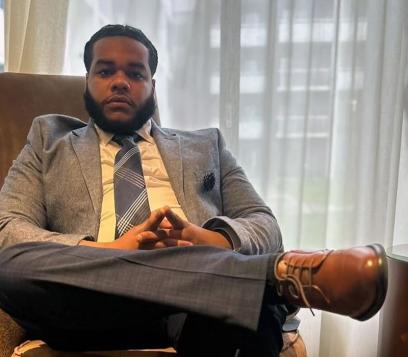
Sharod Blackwell has been a paraeducator since his shiny new career began: a one-to-one para from 2023 to 2025, and what his school district calls a “teacher on record” since then, working alone in two classrooms with some of the district’s most troubled teens.
“He has a heart for it,” says Hope Wyatt, president of Blackwell’s local union, the Norwalk (Conn.) Federation of Educational Personnel. “Sharod wants to see the young people succeed. That’s so important. He’s very kind, very courteous, just a good young man.” She also calls him “an ‘everything’ person: big brother, father, uncle—that all-around person, and somebody they could talk to.”
Blackwell recently earned his license as a registered behavior technician, which equips him for almost any kind of behavior intervention. He works as a para in charge of two adjacent high school classrooms. Each student works at a different level, so he bounces back and forth among them, helping them complete their assignments.
“I assist them for whatever they need,” he says. “And I love doing it. I enjoy the students.” Some of the teens have been suspended; others feel down or disconnected. Blackwell takes pride in “building a foundation with them, giving them the guidance they need. Everybody makes mistakes; building their characters back up and making sure they succeed, that is my goal.”
Already, Blackwell loves running into former students at high school games or around Norwalk. “They’re really happy to see me,” he says. “Seeing them back with that positive attitude again, giving them that light again, you know?” They thank him, and he can see he’s made an impact on their lives.
Blackwell also helps out in sports. Recently, he went to another high school where all the special ed students competed in basketball, track and soccer. There, he set up practices and helped keep the students engaged. “I like to get involved,” he says. “Anything with the kids is a no-brainer for me.”
In a way, his career was a no-brainer because every adult in his family works in the public schools. After his main job at Norwalk High from 7 a.m. to 3 p.m., Blackwell goes to Silver Mine Elementary School and works at an after-school program until 6 p.m., a gig he’s had since about 2016. There, he helps kids with all kinds of activities, from homework to reading to gym.
It can be challenging getting children to let their guard down, but he regards that as “a skill that I can do.” While sometimes he doesn’t know what a kid is going through and wonders what’s happening at home, he still understands his students better than most: “If a kid went to the principal, the principal will come and ask me.” He feels good about heading off trouble.
Blackwell sees his future in a program with more kids and definitely “the right resources. I’d open it more after hours and offer more resources that I know the parents don’t have, like tutors.” He’d like elected officials to come out, see what’s needed and fund it.
From generation to generation

Another rising star in Norwalk is Jessica Joseph. Busy volunteering at the union office for years, Joseph is now a paraprofessional, last year working at a middle school and this year at an elementary school.
Local union leader Hope Wyatt had encouraged Joseph to become a paraprofessional. And now? “She has become a para and a rock star,” Wyatt says. “We’re so proud of her.”
Joseph is a product of the Norwalk Public Schools, so she knows her turf. From there she graduated from Norwalk Community College and Western Connecticut State University. Her mother, her brother and Jessica all got their associate degrees at the same time.
Around 2023, she started volunteering in the union office: filing, listening to union stories, seeing members’ faces, hearing their names and pulling together the union’s newsletter. “I wanted to help out more. I wanted to give back to the community,” Joseph says, so she applied for jobs with the public schools.
In 2024, Joseph became a one-to-one paraeducator at West Rocks Middle School. She likes accompanying students to class and learning together. This year, she has worked as a building para at Tracey Magnet School, a K-2 elementary school. It’s fun for her to rotate through subjects and grades, helping the art teacher prepare and helping other teachers with spelling, grammar, science and math. She also covers lunch and ends her day with kindergarteners.
“They’re really sweet,” she says. “There’s one class where I give them stickers when they complete their work or show good character. I like to watch them grow and learn.” Before winter break, she helped them build houses for the three little pigs; the houses were waterproof, windproof and wolf-proof.
But here’s the key to Jessica Joseph: “A lot of the people I see and work with, they’ve helped me since I was a little girl. They were my paras. At the time, even though I didn’t know they were watching over me, they were watching over me and helping me learn.”
Removing barriers, repairing harms

Teanna Tillery knows the value of good attendance. In 2002, she went to work for the San Francisco schools as a paraeducator in truancy and attendance intervention. During the 2008 recession, the state converted funding to block grants, which caught her and many other educators in a series of monthlong layoffs.
Tillery can tell you about layoffs. About what they do to kids and schools. She has, in fact, told the San Francisco school board about layoffs and the importance of paras. The district offered her a job as a community relations specialist, a paraeducator position, doing attendance intervention. Later she went into management as an attendance manager for the district, and then, as she puts it, “came to my senses” and went back to being a paraeducator.
The need is huge. Among the many barriers to kids’ attendance are homelessness, violence and their caregivers’ mental health. “Sometimes students have to be the parents, stay home and take care of their parents and other siblings,” Tillery says. “Sometimes, the parents don’t trust schools because they feel we’re trying to take their children away from them.”
All the while, Tillery has been engaging with her union, the United Educators of San Francisco, a 6,500-member local with 1,700 paras. She became a union officer. Two years ago, the lowest-paid para made about $19 an hour. Now, after UESF’s recent strike, everyone will make at least $31 an hour.
“It’s the power of organizing,” she says. “And it will give us power to continue next time around.”
So what does “attendance intervention” mean? For kids who’ve been away from school awhile, it means re-entry and course credit recovery. Attendance paras monitor kids’ records, do home visits and try to find places where students congregate. They suss out phone numbers for family members, and they find out what’s going on. They remove barriers. They repair harms.
As a member of the School Attendance Review Board, Tillery would spend one hour per family, “giving them 15 minutes to curse me out, convincing them that I’m not calling child services on them, getting them to trust me with the info they’re sharing with me, and getting them to see that it’s going to be OK.”
Compulsory laws around attendance don’t help families, she says. The better idea is to move them away from fear to a place of support.
“Kids may think they’ve messed up so badly there’s no hope, but you can show them that it’s still not too late and they can get back on track and graduate,” Tillery says. They may not be the same type of credits or the same diploma, but they can graduate.
Her favorite part? “Honestly, it’s the students—when they realize it’s not too late, based on the transcripts, they start to see, ‘Wait, I can graduate!’ It has to be my favorite part of the job.”
[Annette Licitra]