 Member Benefits
 How to Join
 En Espanol
Devices-down, eyes-up, hands-on learning
AI doesn’t change the essential purpose of education: teaching students how to think.
I can pinpoint the moment when my unease over young people drowning in technology—cellphones, social media, AI chatbots and the digital deluge—veered into outright alarm. I was talking with Jonathan Haidt, a researcher and the author of The Anxious Generation, when he was an AFT Book Club guest. Haidt laid out the myriad ways all this tech is affecting our kids—making so many of them sedentary, solitary, anxious and depressed, and likely harming their cognition, attention and academic achievement. That was my OMG moment.
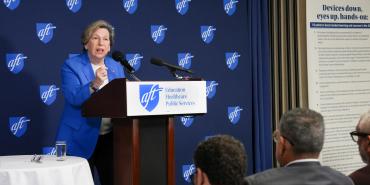
Down the tech rabbit hole I went—diving into research, talking with parents and educators, and delving into my own grandchildren’s experiences. All this reading, listening and thinking culminated in the “devices-down, eyes-up, hands-on” education strategy I recently detailed in a speech, which you can find at aft.org/DevicesDown.
Whatever the future holds, students need a broad base of foundational knowledge, curriculum that is relevant and engaging, opportunities for active learning through meaningful projects, and safe and welcoming classrooms where they feel seen, supported and ready to learn.
One thing the age of artificial intelligence doesn’t change is the essential purpose of education: teaching students how to think. In fact, the ubiquity of AI makes critical thinking and applying knowledge even more important. Students need to go beyond memorizing facts and learn how to verify and challenge them. Some of the most valuable skills in the AI age—like problem-solving, communication, collaboration, adaptability and ethical judgment—require the ability to apply knowledge. But AI is increasing so-called cognitive offloading; rather than working through a challenge, students turn to a chatbot for an effortless answer.
Hoping the Trump administration will help us navigate these issues is like waiting for Godot. It appears to want tech bros in charge. And too many state education leaders are keeping their heads down. So in my speech I offered a 10-point plan to boost student learning and success. It takes on the tech earthquake by calling for: limits on screens and student-facing AI, an enforceable privacy standard for AI in schools, more project-based learning, protections for intellectual property, and a tax on Big Tech’s earnings to compensate the country for the consequences of this tech takeover.
Parents have expressed support and appreciation. Teachers union leaders plan to use the plan in contract negotiations. And some school districts have invoked it as a rationale for change.
I am not calling for an AI ban or a Chromebook bonfire. I’m advocating to get the balance right to harness the benefits of technology and mitigate the harms. AI is here to stay. We need enforceable guardrails. We need help to cushion the disruption to people’s lives. And educators and parents must understand AI and have a say in its use in education.
That’s why the AFT created the National Academy for AI Instruction last year, to help teachers master AI so it doesn’t master them, and to guide their students to safely navigate the digital world. The academy’s most in-demand class is about cognitive offloading and critical thinking. Teachers learn how to foster the productive struggle that sparks learning, rather than students outsourcing thinking to AI.
The crux of this “devices-down, eyes-up, hands-on” approach is prioritizing active learning through meaningful projects—from play for our littlest ones, to debate for older kids, to music and art for all. It’s the opposite of drill-and-kill, learning things for a test but not for a lifetime.
The global education technology market was estimated at $187 billion in 2025. But research has established that less tech can produce better outcomes and tech dollars could be much better spent. Study after study shows that investments in public schools improve student outcomes, while funding cuts hurt outcomes. Yet 42 states devote a smaller share of their economies to their K-12 public schools than they did in 2006, a loss of hundreds of billions of dollars. This disinvestment is particularly acute in states such as Arizona, Florida and Texas, where vouchers are exacerbating underfunding and underachievement.
We must stop the runaway train that private school vouchers are becoming. Vouchers have produced some of the largest declines in student learning in the research record, and they take vital funding away from students in public schools to benefit private interests. That’s why education union leaders from across the country are urging Democratic governors to reject President Donald Trump’s private school voucher tax credit program and to publicly reaffirm their commitment to public education.
I believe our 10-point plan responds to the country’s wants and needs. Parents want their kids to be engaged and well-prepared. Young people want school to be interesting and relevant. Employers need well-prepared workers. And, on the 250th anniversary of our founding, America is crying out for a unifying vision for our future.
Learn more at aft.org/DevicesDown.