 Member Benefits
 How to Join
 En Espanol
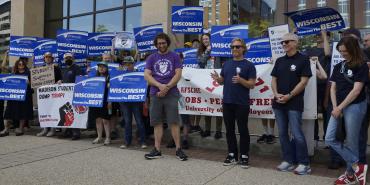
On September 18, 2025, 74 of my fellow union leaders from across the University of Wisconsin (UW) system and I converged in the state capital to rally for a voice in the UW system. Though higher education workers in every other state around Wisconsin have the right to collectively bargain, we do not. Our ongoing fight began in 2011 when the then-newly elected governor, Republican Scott Walker, rammed Act 10 into law despite protests that drew tens of thousands of working people. Act 10 forces preK–12 teachers, technical college faculty and staff, and almost all state employees to hold annual certification elections for the “privilege” of collective bargaining that is restricted solely to base wages and is capped at the rate of inflation. As a result, most public employees are unable to negotiate healthcare benefits, pensions, or working conditions.
For those of us serving the UW system, Act 10 goes further: We can’t even certify our elected union leadership to negotiate with management over anything.
But we’re still fighting for a say in how our campuses are managed and how our students are served—and we’ll continue until we win. Republicans in Wisconsin could not take away our First Amendment rights or our right to form unions (even if they are not recognized as such). Today, AFT-Wisconsin has members on all 13 campuses in the UW system with autonomous, locally elected leadership. Our ultimate goal is to win full collective bargaining rights so we can ensure university resources are allocated to supporting students and to providing fair wages, benefits, and working conditions for faculty and staff. For now, we regularly call on campus administrators to exchange ideas on salaries and working conditions, a process often referred to as “meet and confer.”
While meet and confer is a step short of collective bargaining, it ensures that faculty and staff have a seat at the table as administrators make decisions about the allocation of campus resources. Though meet and confer consists of a nonbinding series of meetings, it has nevertheless been viewed as nothing but a threat by most chancellors, who, from what I’ve observed, want to keep every ounce of managerial discretion for themselves.
We Will Not Back Down
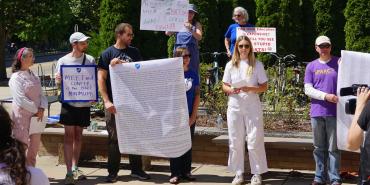
As if revoking our collective bargaining rights were not bad enough, extremist Republicans in Wisconsin also enacted a series of brutal budget cuts between 2011 and 2018 (the year that Walker lost his bid for a third term as governor). Democratic Governor Tony Evers, who took office in 2019, has tried to replace some of the roughly $1 billion lost to Walker’s war on “woke” professors, but the Republican-controlled legislature remains committed to Walker’s agenda. Just a few years ago, for example, Republican Assembly Speaker Robin Vos withheld funding for UW employee raises and for capital projects, demanding that everyone whose work promoted diversity, equity, and inclusion (DEI) be fired. At the same time, the legislature cut another $32 million from the UW budget because that’s what they guessed the UW system spent on DEI efforts. (Evers saved 188 DEI positions by veto but was unable to restore the funding.1)
Seeing these attacks on higher education and the rights of working people, I’ve spent the past decade becoming more and more active in my union. I joined the fight in 2013, when I became a professor of democracy and justice studies at UW–Green Bay. In 2014, I began serving the first of four terms as vice president for higher education of AFT-Wisconsin, and in 2022, I was elected president of UWGB-United, the faculty and staff union at UW–Green Bay. In 2025, I was elected president of AFT-Wisconsin. I sketch my personal journey simply to make one point: AFT-Wisconsin will not back down from this fight. No matter how long it takes, we will eventually win the voice we deserve on our campuses, and we will use it to create the learning and working conditions necessary to restore the UW system to its former place as one of the best public universities in the United States.
Our Meet and Confer Battles
Over the past 15 years, thousands of UW faculty and staff have traversed paths similar to mine—becoming interested in the union, developing skills as dedicated activists, and taking on leadership positions. Sadly, our drive comes from repeatedly enduring the consequences of poor decision-making by UW chancellors.
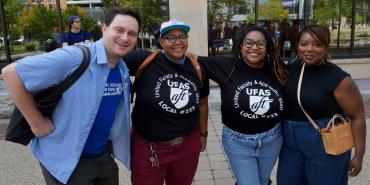
For example, in 2018, the administration at UW–Stevens Point sought to eliminate several humanities majors in the face of over a decade of decreased funding. And in 2023, the chancellor at UW–Oshkosh sought to eliminate over 200 positions to deal with a budget shortfall. In each case, our locals fought back, mostly defeating Stevens Point’s “Point Forward” proposal2 and organizing a no-confidence vote in the Oshkosh chancellor —in no small part because he refused to meet with us—that ultimately ousted him.3 Though we made some wins in these arenas, it was clear that we will continue to face these attacks until we build more power on our campuses.
The silver lining has been that since 2011, hundreds of new members have joined our UW locals. Building on that strength, we’ve been finely honing the tools we can use outside of collective bargaining to have our voices heard. In September 2023, we held a statewide higher education summit, convening leaders from almost all of our local UW unions. That November, a group of six locals formally asked their campus administrations to engage in a regular “meet and confer” relationship. Every one of those chancellors either ignored us or said no.
So we took action. At UW–Green Bay, the local held a weeklong “demonstration election” on campus. Union activists held in-person voting in public spaces, asking colleagues to drop by and vote in support of meet and confer. The result, in a public vote count, was almost 200 “yes” votes to only one “no” vote. Other locals built on the meet and confer campaign. The Teaching Assistants’ Association at UW–Madison played an essential role in mobilizing faculty and staff to push for paid parental leave. Even though the local does not formally have meet and confer, the pressure brought was so great that the administration finally agreed to it in April 2024, with the policy going into effect in July.4 By the summer of 2024, another four locals had asked their administrations to formally engage in meet and confer.
Still, administrators and chancellors across all 13 campuses largely ignored us, so in August 2024, we ramped up our tactics. We decided to go above our chancellors to the UW system’s Board of Regents. Almost all of the regents are appointed by the governor (the two exceptions are the state superintendent of education, who is elected and has an automatic seat on the board, and a representative of the Wisconsin Technical College System Board). Regents serve seven-year terms; by 2024, almost all of them had been appointed by Governor Evers. AFT-Wisconsin members had fought hard to help Evers win his 2018 and 2022 elections. He had campaigned on the importance of worker voice as well as ensuring that the UW system is fully funded and that students have the resources they need to succeed. Given our shared values, we believed the regents would be immediately favorable to meet and confer.
We held an action outside the Board of Regents meeting that August with UW union members from around the state,5 garnering a great deal of media attention.6 Our intent was to announce to the regents that we would be asking them to pass a policy mandating that our chancellors meet with us.
Much to our surprise, only one regent was supportive: State Superintendent Jill Underly has not only understood the importance of meet and confer but also helped our cause immensely by educating other regents. Still, her colleagues on the board remained silent. We weren’t sure whether they didn’t want to talk with us or they wanted to see the governor support it first. Naively, we again expected a breakthrough in September after Evers announced his support of meet and confer.7
Ramping up yet more, in October we launched an email writing campaign, in which UW workers added their personal stories detailing why we need meet and confer to a template email sent to every single regent. We sent hundreds of these emails. As one member from United Faculty and Academic Staff (which is on the Madison campus) put it,
If you share any of my concerns about the collective political moment in which we find ourselves and blatant, persistent attacks on democracy, I hope you recognize the need and opportunity in this moment to chart a different course for our institutions—one where we trust and follow the lead of staff, faculty, and students; share power; problem-solve collectively; and prioritize impact over hierarchy and bureaucratic precedent. We have nothing to lose by working together and leveraging the voices of those who know their university from the inside out and are already volunteering time and labor to work towards change for the good of all of our campus community members.
A member from UW–Whitewater United wrote,
During my own time in graduate school, we mobilized to make sure that graduate workers would be able to hold on to the benefits that they earned. Since coming to Wisconsin, I’ve become even more aware of issues that can and have affected our ability to deliver on these things to our students and each other. I’m a firm believer that employees … [must] have a seat at the table to ensure that conditions are being met effectively and to the benefit of all.
We also sent a public letter to the regents that was signed by a number of state legislators (including two gubernatorial candidates as of this writing, Representative Francesca Hong and Senator Kelda Roys) and other prominent supporters.8
The Power of Solidarity
As it became clear that even with Evers’s support this would not be an easy fight, we developed a statewide plan, drawing on our solidarity throughout AFT-Wisconsin and with the AFT national union. At our statewide virtual kickoff in October 2024, we were joined by AFT President Randi Weingarten, who helped inspire our members by putting our efforts in the context of national politics; she emphasized the importance of workers having a voice in Wisconsin no matter the outcome of the presidential election. And in December, we learned that we won one of only three AFT Real Solutions grants awarded for higher education. That $60,000 grant allowed us to hire an additional field organizer.
By the spring of 2025, we were able to engage in several interrelated campaigns, which was necessary because although a few regents were willing to meet with us, many remained unresponsive. To make ourselves harder to ignore, we attempted to engage in direct action. Inspired by the tactics of Michael Moore in Roger & Me,9 we sought a meeting with Board of Regents President Amy Bogost,10 only to encounter a locked hallway preventing us from even coming near the board’s office, which is at the top of one of the highest towers on a UW campus. The inaccessibility struck us as a metaphor for the ways administrators across the state had ignored the needs of their workers.
Undeterred, we held actions at individual regents’ places of employment, showing up to ask for meetings.11 We also ran a public-facing campaign to ask Evers to appoint our own candidates for the board when two vacancies came up that spring.12 Though a technicality* prevented the governor from making the appointments we wanted, he appointed one of our candidates to the Wisconsin Technical College System board,13 and the two new regents he appointed in 2025 have been very responsive when we’ve asked for meetings.
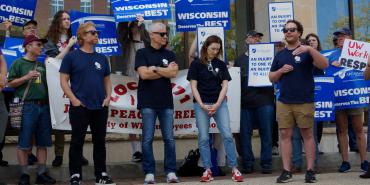
In the summer of 2025, most of the regents—including Bogost—finally began to meet with us. Soon after the start of the school year, we hosted a strategic action to pressure the regents to put meet and confer along with union recognition on the agenda for their October meeting. To ensure we were heard and seen, we began with a rally outside the Board of Regents office just before its September meeting began, then took dozens of members inside for the beginning of the meeting and walked out silently once the meeting started.
Unfortunately, we’re still waiting for the board to act. Throughout the fall, the regents were consumed by two very important (and deflating) challenges after Republican legislators used the budget process to micromanage faculty workloads and UW system administration restricted campuses’ freedom to enact their own general education curricula.
Meet and confer has not yet made it onto the Board of Regents’ agenda, but we have a few more meetings before this fall’s all-important election, and we anticipate getting the regents to pass this policy in the coming months. None of us thought it would take this long to get here, and we are still going to have to put some pressure on the board to get this over the finish line. Once we get there, it’s going to take even more work to establish productive meet and confer processes and relationships, but this is one more step to building the system of higher education we—and our students—deserve in Wisconsin.
Jon Shelton is the president of AFT-Wisconsin, a former president of UWGB-United (the faculty and staff union at the University of Wisconsin–Green Bay), and a professor and the chair of democracy and justice studies at UW–Green Bay. He serves on Green Bay’s Equal Rights Commission, and his most recent book is The Education Myth: How Human Capital Trumped Social Democracy.
*By state statute, there must be a regent in each of our eight congressional districts, and neither of our preferred candidates would have filled a vacant district. (return to article)
Endnotes
1. H. Venhuizen, “Wisconsin Republicans Withhold University Pay Raises in Fight Over School Diversity Funding,” Associated Press, October 17, 2023, apnews.com/article/university-wisconsin-legislature-diversity-dei-pay-raises-ddee5255f27e54da9a36e2a76b0f5489.
2. WSAU Radio, “UW-Stevens Point Scraps Point Forward Proposal,” WXPR Public Radio, April 11, 2019, wxpr.org/arts-life/2019-04-11/uw-stevens-point-scraps-point-forward-proposal.
3. J. Schulz, “UW-Oshkosh Faculty Vote No Confidence in Chancellor Amid Layoffs, Budget Challenges,” Wisconsin Public Radio, April 5, 2024, wpr.org/news/uw-oshkosh-faculty-vote-no-confidence-chancellor-layoffs-budget.
4. J. Herath, “UW Employees to Be Offered Paid Parental Leave,” Badger Herald, April 3, 2024, badgerherald.com/news/campus/2024/04/03/uw-employees-to-be-offered-paid-parental-leave.
5. G. Escott, “‘We Deserve a Seat at the Table’: UW System Unions Protest as Board of Regents Passes Mass Faculty Layoffs,” Daily Cardinal, August 24, 2024, dailycardinal.com/article/2024/08/we-deserve-a-seat-at-the-table-uw-system-unions-protest-as-board-of-regents-passes-mass-faculty-layoffs.
6. J. Cestkowski, “UW Staff Demand Action, Attention from University Administrators,” WKOW, August 22, 2024, wkow.com/news/education/uw-staff-demand-action-attention-from-university-administrators/article_34aae386-60dd-11ef-ba29-23cd7c89be4c.html; and Escott, “‘We Deserve a Seat.’”
7. J. Cestkowski, “Governor Evers Endorses Meet & Confer While UW Unveils New Excuse for Not Meeting with Grad Workers,” TAA Graduate Worker Union, September 25, 2024, taa-madison.org/evers-endorse.
8. AFT-Wisconsin, “Support Our UW System Workers in Their Fight for the Public Higher Education We All Deserve!,” actionnetwork.org/petitions/support-our-uw-system-workers-in-their-fight-for-the-public-higher-education-we-all-deserve.
9. Zinn Education Project, “Roger and Me: The Story of a Rebel and His Mike,” zinnedproject.org/materials/roger-and-me.
10. S. Clark, “UW Board of Regents Refuse to Meet with Representatives of AFT-Wisconsin,” WORT, March 14, 2025, wortfm.org/uw-board-of-regents-refuse-to-meet-with-representatives-of-aft-wisconsin.
11. V. Frazier, “UWGB Union Members Demonstrate Outside Board Member’s Office Ahead of April Regents Meeting,” WBAY, March 28, 2025, wbay.com/2025/03/28/uwgb-union-members-demonstrate-outside-board-members-office-ahead-april-regents-meeting.
12. L. Beran, “Union to Evers: Appoint Pro-Labor Members to UW Board of Regents,” Isthmus, April 29, 2025, isthmus.com/news/news/union-to-evers-appoint-pro-labor-members-to-uw-regents-board.
13. Office of Alderman DiAndre Jackson, “Statement on Appointment of Dr. Michael Rosen to the Wisconsin Technical College System Board of Directors,” City of Milwaukee, October 15, 2025, city.milwaukee.gov/ImageLibrary/Groups/ccCouncil/News/2025/District-07/07---Dr.-Michael-Rosen-Statement.pdf.
[Photos courtesy of the author]