 Member Benefits
 How to Join
 En Espanol
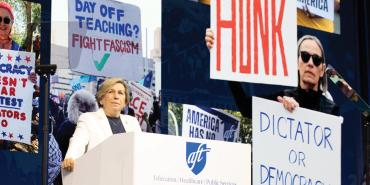
In the United States, there are now 1,000 billionaires—and the world’s first trillionaire—at a time when nearly half of American households—46 percent—don’t earn enough to make ends meet.
This wealth imbalance—the top 1 percent having as much wealth as the entire bottom 90 percent of Americans combined—has led to a power imbalance that affects the lives of everyone in our country. These oligarchs influence policy. They have the power to undo social progress. To sway financial markets, monopolize the media, buy elections, and undermine democracy.
But this is what they don’t have: the power of the people.
That’s not a mere slogan; it’s the potential to work together, to bargain together, to protest together, to vote together, to act together to bring about change. That is the power and potential of our movement and of the AFT.
The AFT is the fastest-growing union in the AFL-CIO. I am thrilled to announce that, despite everything that’s been thrown at us, we have hit a historic milestone: The AFT is 1.875 million members strong!
Half of all nonunion workers in the United States want to join a union, but only 1 in 10 belongs to a union. In the mid-20th century, when 1 in 3 American workers were in a union, we had the largest middle class and the lowest income inequality. That’s why, in the long term, growing the union movement is key to solving America’s affordability crisis.
But what do we do now? We’ve got to win elections. And here’s why.
As I said, 46 percent of households—55 percent of households of color—did not earn enough to make ends meet in 2024. And inflation has soared since then. That means there’s not enough to put food on the table, put gas in the tank, and still cover rent. It means constant stress and struggle.
Our members see it every day in the people they teach, heal, and protect. And our members feel it.
This winter we surveyed AFT members about the financial issues that keep them up at night, and 7,500 responded. Nearly three-quarters reported living paycheck to paycheck, and more than a third said they were unable to cover all of their monthly bills.
President Donald Trump isn’t worried about being able to afford healthcare, housing, or anything else. Since returning to the White House, he has raked in more than $2.2 billion, through what government watchdogs call unprecedented corruption and self-dealing.
We’re not holding our breath for the president to deliver on his promises to lower costs. We’re fighting for economic security and to put more money in our members’ pockets—like the one million borrowers we’ve helped get Public Service Loan Forgiveness relief. Our Fight for Affordability builds on that work, with resources to help navigate medical and credit card debt and other support people are legally entitled to but may not know about (see the sidebar here). And our One Big Bill campaign highlights the devastating consequences of Trump’s Big Ugly Bill—like spiking student loan payments—and uses those stories as a basis to fight for much-needed relief (visit here to share your story).
We are working with allies in Congress on bold solutions, like increasing the minimum wage to $25 and passing the Working Americans’ Tax Cut Act, which would exempt 104 million lower-income adults from federal taxes—paid for by millionaires paying a fairer share. We’re pushing for increased funding for public schools and colleges. We’re fighting back against the draconian cuts to Medicaid and to rural hospitals. Millions of children risk going hungry because of the heartless changes to the Supplemental Nutrition Assistance Program in the Big Ugly Bill; we are fighting for every single one of them.
But we need majorities in statehouses and in Congress this year, and ultimately the White House, to secure the foundational changes we seek.
To get a working-class tax cut, to pass living-wage legislation, to get limitless money out of politics, to fix the healthcare system, to strengthen public education, and to restore vital safety net and climate programs, we have to elect people who support working people, leaders with real plans to make life better.
Strengthening public schools and stopping the reckless runaway train that private school vouchers are becoming should not be a partisan issue. Ensuring everyone who works can earn a living wage should not be a political issue. Fighting so everyone has access to high-quality, affordable healthcare should be a human priority, not one party’s priority. Shoring up Social Security to keep seniors out of destitution should have universal support. Addressing the climate crisis that threatens all humanity should unify all humanity.
This election will decide whether we are a country governed by the people or ruled by the powerful. A country of opportunity or oligarchy. A country whose people live in freedom or in fear.
That’s what’s at stake in November 2026. People power can win, but we need to be all in. No one can do everything, but each of us can do something to win in November and achieve the better future we fight for.
[Photo credit: Pamela Wolfe]