 Member Benefits
 How to Join
 En Espanol
The energy was high on Thursday afternoon as AFT Higher Education division delegates packed a meeting room to overflowing to discuss what’s at stake in this year’s midterm elections. The meeting was hosted by Eric Rader, president of the Henry Ford Community College Federation of Teachers, AFT Local 1650, and AFT Higher Education program and policy council co-chair, who shared organizing victories from the last year. He also reminded delegates, “Our civil liberties are under attack, but we are ready to meet the moment.”
He was followed by Joe Dennison, senior associate director of the AFT’s political department, who reiterated that the midterms are a referendum on the direction of our country. “We have the opportunity to make sure this is the direction we want to go,” Dennison said. He encouraged members to sign up to phone bank, text, write postcards, canvass and volunteer as “Democracy Defenders” so that we can make sure every vote is counted.
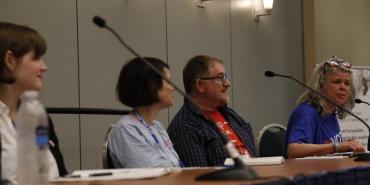
During the meeting, delegates heard from a panel of activists from blue, red and purple states about how they’re organizing to get out the vote on their campuses. The panel was moderated by Ken Mash, president of the Association of Pennsylvania State College and University Faculties.
Laureen LeFever, first vice president of the Montclair State Federation of Adjunct Faculty, AFT Local 6025, remembered that when she turned 18, her family celebrated her first time voting with a cake. “That’s the energy I bring to voter registration at Montclair State,” she said. Her campus celebrates National Voter Registration Day with a big party for students, where her local partners with the full-time faculty local to host a voting trivia game. They’re also coordinating with student groups to build civic knowledge and encourage voter registration and turnout.
Rob Kilgore, vice president of the South Carolina Conference of the American Association of University Professors, said that the road to democracy in South Carolina goes through civil rights. Public sector bargaining is illegal in South Carolina because a mostly Black group of sanitation workers tried to unionize in the 1960s. “Knowing that history is part of the work,” according to Kilgore—as is having the humility to recognize the valuable knowledge and experience of the community organizations they partner with. Fighting K-12 book bans is one major avenue for activism because “these fights are our fights too.”
Clara Conover, lead organizer for the Ohio Student Association, organizes students on 12 campuses and is part of the largest youth voter campaign in the state. The right to vote is under attack in Ohio, where federal agents have raided voting rights organizations and tried to intimidate voters, but the campaign is not backing down. They’ve already registered more than 25,000 student voters this year. Higher education is also under attack, but Conover knows that “when we work together, we can take powerful swings.”
Belle Boggs, president of the North Carolina State Conference of the AAUP, described the uphill battle her union faces in a state with a long history of gerrymandering, voter suppression, poor healthcare and poorly paid faculty who aren’t used to thinking of themselves as workers. They have to get creative and work in coalition with community organizations and with students. Together, they fought off a Republican supermajority in the state Legislature for a year, and they keep fighting. “We focus on incremental issues and wins, take meetings with anyone who wants to meet with us, call people and learn even from things that feel like losses,” Boggs said. “We have to celebrate the small wins because that’s how we get to the bigger ones.”
[Sharone Carmona/Photo credit: Pamela Wolfe]