 Member Benefits
 How to Join
 En Espanol
They call it their two-year adventure, and it does seem more like a psychological thriller than a story about school meals. Either way, AFT Tulsa President Nancy Leonard, together with Ginnie Holly, a certified dual site cafeteria manager for the Tulsa, Okla., public schools, used their wits to overcome a corporation and its disgusting food.
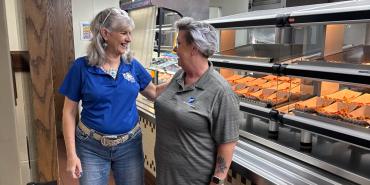
Holly watched in growing horror as she worked in the cafeteria for almost 10 years, starting as a café assistant, then as a cook and a manager at Will Rogers College Middle and High School. First, she had to deal with a giant company called Sodexo, which the school district had been using for a long time but whose representatives didn’t listen to what school employees had to say.
Then in 2024, after the district replaced Sodexo with another corporate giant called Aramark, Holly and Leonard decided to speak out.
“There were a bunch of us who said ‘Nuh-uh, we’re going to get smart!’” Holly declares. From the start, Aramark’s manager was “just atrocious and was union-busting on the side.”
What the company was supposed to be doing was procuring food, preparing state-approved menus and creating tasty and nutritious recipes for school meals. What it actually did was deliver spoiled food, including sour curdled milk that poured out in chunks, as reported by students and documented by a local newspaper.
One company manager verbally abused the cafeteria staff, Holly says, describing her as “rude and condescending, hateful and short” in speaking to certain food service workers. This manager also wrecked a school district vehicle and tried to hide it from the district. And a company chef called the staff “little bitches,” while a company salesman insulted the cafeteria employees during a school board meeting, prompting about a dozen of them to walk out.
Amazingly, the school board rehired Aramark for another year, which just ended. By that time, AFT Tulsa had a box full of email correspondence documenting problems with Aramark’s low-quality menu choices, recipes and food, says Holly, who also is a member of the Central Oklahoma Labor Federation.
“At that point, more cafeteria managers joined in and started using their union voices” to spell out exactly what Oklahoma and the federal government require for school meals, Holly says. For her part, she had gained enough confidence by the summer of 2025 to search online and pull up a school report documenting the district’s problems with Aramark. She also found lawsuits (too many to list) against Aramark nationwide.
This prodded the district’s chief operating officer to start a conversation among school café managers, school administrators and Aramark—sometimes in-person and sometimes on Zoom. Documentation by AFT Tulsa lasted through the 2025-26 school year to hold the company accountable for its service, Holly says.
Gaining ground, inch by inch
Leonard and Holly found their biggest ally in Calvin Moniz, the board of education’s vice president. When Aramark wasn’t gone by last summer, the union reached out to Moniz, Leonard says, “because I found out that Calvin’s mom had been a school nutrition lady. She was a lunch lady!”
AFT Tulsa opened a dialogue among school employees, the district, the school board and Aramark, finding a way to call out the corporation’s inadequacies without suffering retaliation.
For one thing, the company didn’t publish menus on time. Company officials wouldn’t listen when told that kids refused to eat certain items. Well before the end of the 2025-26 school year, the district put in a request for the first five weeks of the coming school year, but Aramark still hadn’t placed the food orders by May.
The company didn’t communicate, Holly says. The cost of food items was way off. The company obscured some things and didn’t explain others. Nutritional requirements didn’t make sense. Serving sizes varied wildly.
Holly tried to prove that if Aramark would just shrink the menu and carry fewer items, the meals would cost less. Plus, Aramark’s calculations were off by anywhere from 50 cents to two dollars per meal. For the district’s nine high schools and 60 elementary schools, the numbers simply didn’t add up. Using their own money, staff members bought lactose-free milk for kids who needed it.
The resulting stress took a toll. Between corporate mismanagement and daily complaints from students, Leonard says of Tulsa’s food service workers: “They’d just cry on my shoulder.”
Finally, the school employees spoke up, saying: “We don’t want to feed this yucky mess to these babies anymore.”
“Why in the world is manager so-and-so at X school having to spend $75 out of her own paycheck to buy this?” asks Leonard, who is also a vice president for AFT-Oklahoma and the first woman in 40 years elected president of the Northeast Oklahoma Central Labor Council. “Why? Because Aramark wouldn’t do it.”
AFT Tulsa learned of other abuses. For example, Aramark was kicked out of a correctional facility for feeding inmates bologna sandwiches for three months straight. “There’s so much litigation, it stretches from the East Coast to the West Coast,” Leonard says. “Our Houston brothers and sisters, too.”
For a while it went on this way: back and forth, cat and mouse. “Please listen to us,” AFT Tulsa told the community. Finally, the union got everyone in front of the superintendent and laid out what Aramark, by law, could and couldn’t do. Aramark cannot reprimand school employees. It can’t hire, fire or conduct evaluations. It can’t take on any school district role unless it’s in the contract.
Cultural failures
Tulsa is a diverse city. One corner of the community is Hispanic, another African American and another Asian and Muslim. The schools cater to diverse tastes.
For instance, empanadas are supposed to be corn masa pockets filled with seasoned meat and then fried. Instead, Aramark’s recipe instructed cafeteria staff to make empanadas out of breakfast biscuits dipped in sugar and cinnamon, filled with meat and baked.
Aramark’s version of a Reuben sandwich was whole wheat bread, sliced turkey, coleslaw and Swiss cheese, instead of an authentic Reuben made of marbled rye bread, corned beef, mustard and sauerkraut. Carnitas are supposed to be shredded pork cooked in citrus and served in corn tortillas with vegetables. Aramark’s carnitas featured shredded turkey.
Lunches for Thanksgiving 2024 drew this reaction from Holly: “OOOH, yeah.” Students were supposed to receive a traditional Thanksgiving dinner, she says, “because for some kids, that’s the only Thanksgiving meal they get.” That year, Aramark didn’t provide nearly enough turkeys.
A happy ending
Ultimately, the school board had seen enough. For the upcoming school year, Aramark will be phased out and the district’s free, universal school meals will be ordered and prepared in-house.
The chief operating officer of Tulsa’s schools says he wants his legacy to be that no one can ever outsource the city’s child nutrition again. From four bonds to pay for school transportation, student services and the restoration of child nutrition, the schools will get ovens, steamers, small wares and food storage, as well as refurbished kitchens. And food.
“When Tulsa starts ordering chicken tenders,” Holly says, “it’s going to be actual muscle meat instead of chopped-up yuk.”
[Annette Licitra]