 Member Benefits
 How to Join
 En Espanol
As we celebrate the 250th anniversary of the Declaration of Independence, our democracy is at risk. We face increased polarization—often arising from misinformation and disinformation that instill fear, anger, and distrust—as the Trump administration draws the nation ever closer to authoritarianism.
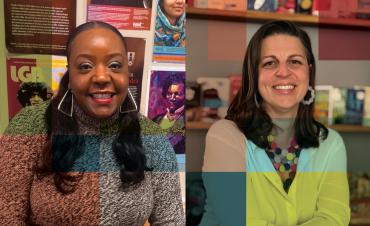
But change is possible. Our voices still matter, and the people still have power. This fall, we need to not only get out the vote but also ensure our students and their families understand the stakes. To learn how teachers are addressing civics education and empowering their students to help heal our democracy, we spoke with two New York educators who are deeply involved in this work through their schools and unions.
is a high school special education and social studies teacher at Cheektowaga Central High School and a member of the Cheektowaga Central Teachers Association. She is also a New York State United Teachers (NYSUT) delegate and political action coordinator. Karissa O’Reilly is a high school library media specialist at Carmel High School and a member of the Carmel Teachers’ Association who advocates for media literacy education at the local and state levels.
–EDITORS
EDITORS: Tell us a little bit about yourselves and what drew you to education, civics, and history.
LASHONDA BRADBERRY: I am from western New York, and I’ve been teaching high school in Cheektowaga, which is a first-ring suburb of Buffalo, for 23 years. I am a special education teacher, but I’m also certified in social studies. Since 2008, I have taught one class outside of my tenure area, an African American history course for 11th- and 12th-graders. I am also a co-teacher in cultural perspectives and literature, and I provide services in a resource room.
I wanted to be a teacher since I was a little girl. I used to study for my social studies tests by lining up my dolls and stuffed animals and teaching them the content I needed to remember. But looking back, my experiences in fourth grade are what sparked my interest in history and civics. I went to a predominantly white school. In fourth grade, I was Sojourner Truth in our play about the US Constitution, and I also was responsible for talking about the 19th Amendment. I remember learning about slavery and all the kids turning around to look at me; I’m like, “I’m learning right with you.” We also learned about Martin Luther King Jr. But I remember thinking, “There has to be more to our history than what they’re telling us.”
At that time, my mother worked for General Motors; she was heavily involved in the United Auto Workers, and she was on the Civil Rights Committee. I remember sneaking and reading her stuff, and I read about Selma and the murder of Viola Liuzzo. I already was in disbelief that people would treat others so badly because of their skin color, but when I saw Viola’s picture, it blew my nine-year-old mind. I could not believe that they killed this beautiful white woman. I slept in the bed with my mom for weeks afterward.
I think that was what pushed me to want to know more, not just then but all throughout high school and in college. I thought that if people only knew more about other people’s perspectives, we could eliminate -isms: racism, sexism, extremism, you name it. I decided I was going to teach those perspectives. That was my whole driving force. I didn’t plan to be a special education teacher, but I was able to go that route and still get the social studies certification. Now, I’m to the point in my career when I can teach electives, and in those courses, I teach what I feel students need or want to learn. So, I’m where I’m supposed to be, doing what I’m supposed to do.
KARISSA O’REILLY: I love hearing your story because my path to education is so different, but the core is the same. I’ve always believed that understanding different perspectives is how we eliminate the extremist views that we see in our country right now.
I’m the library media specialist at Carmel High School in Putnam County, New York. But I did not find my way to education until I was much older. My first career was in magazine editorial. Then I was home with my kids for a while and started volunteering with Comfort Zone Camp, which is for kids who are grieving. I found that I really enjoy working with teenagers. Later, I worked in a bookstore, and I loved connecting people to stories that resonated with them. And then one day I saw an ad for a school media program at Syracuse University, so I went back to school for my master’s.
When I was younger, I never imagined myself teaching. I was the kid who would shake at the thought of getting up in front of the class to talk. And libraries did not appeal to me because they were too quiet with a lot of rules. But libraries have always been mainstays of democracy and cornerstones of equity. They are places where people can go to access needed resources and information—especially for our public schools and our students. And teaching media literacy skills is a critical role for school librarians now.* We’re not just showing students how to access sources; we’re showing them how to understand the information that reaches them. I just finished my sixth year at Carmel, and I really love what I do. It may have taken me a little longer, but I feel like I found my place.
EDITORS: What role do you have in promoting media literacy with your students?
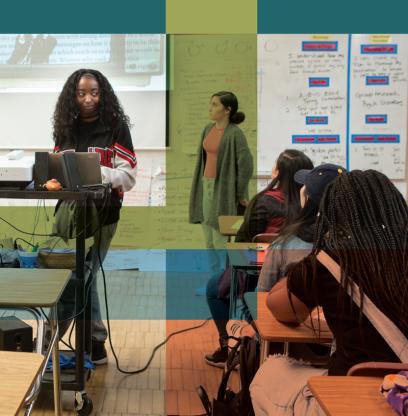
KARISSA: When I went to school to become a librarian, no one could have predicted how social media would take off—especially among young people. I spend far more time teaching about social media than I expected; I also spend time learning about it since the information world is changing so rapidly. During my master’s, I learned to teach research skills, of course, but it wasn’t until I worked with my mentor, who does a lot of media literacy education, that my eyes were opened to how critical it really is for students to have media literacy skills that apply directly to the way they consume information in their everyday lives—and for school librarians to know how to teach these skills. From there, I’ve done tons of professional development, which is critical for staying up to date.
LASHONDA: Exactly. Media literacy is something I have been thinking about for a long time. It’s always blown my mind that there have never really been serious regulations for social media. And now we have AI, which really worries me. I don’t understand why we put so much money into artificial intelligence instead of using the money to fix our roads or invest in high-speed rail or services that help people. Instead, I’m watching my students not feel confident enough to think for themselves without wanting to ask AI, and that bothers me.
KARISSA: I address AI ethics as part of the media literacy elective I teach for 10th- through 12th-graders. I had one student tell me, “I get why AI is useful for scientific research, for trying to solve world problems. But why do regular people have access to it? It’s not good for us in any way.” Some states have implemented regulation, but I see the need for far more guardrails to address the real risks AI poses. Other countries are making progress here. For example, the European Union’s AI Act1 puts a heavy emphasis on protecting citizens; we need something like that here. Without it, the growing use and power of AI is scary.
EDITORS: How do you address misinformation and opposition to teaching honest history?
KARISSA: There’s opposition to so much of what we do in education, whether it’s “public schools are indoctrinating our children,” or “they’re teaching DEI,” or “they’re making kids feel guilty.” We know our intent. We’re just teaching honest history and trying to build a curriculum that embraces all voices and perspectives. But our country’s polarized political climate has made our attempts at equity feel threatening.
I work in a politically diverse community. We’ve certainly seen some of this opposition. As a result, some teachers, myself included, can be nervous to introduce new things to our curriculum or bring up social justice issues.
I’ve never heard a student say they feel guilt around things that are being taught in their classes. I think a lot of this opposition comes from a place of fear, and that fear is driven by misinformation and disinformation. Ultimately, I think what’s behind it—the notion that introducing these ideas to students is somehow threatening to their culture and well-being—is coming from a small number of people in powerful places, and it’s being disseminated through social media for the purpose of instilling fear.
That’s why media literacy is so important. When we understand how information works—how algorithms feed us what we want to see, how bad actors can manipulate information, how we can check up on the accuracy of an emotionally charged post—we become empowered. We learn to look at our social media feeds with a critical eye, and we can more easily have civil conversations with people about hot-button issues. I think of the book challenges in my district. We had people getting really emotionally engaged about books that they had never read because they were being fed inflammatory misinformation through social media. The fear that kids will feel guilty or feel less pride in America by learning honest history is not based in what is happening in our schools. People are being manipulated into thinking it’s even a possibility.
I’ve found that teaching about misinformation generally is well received. Families love that I’m teaching students skills to identify misinformation and disinformation and to find ethical, reliable, credible sources. They’re saying, “I wish I knew how to evaluate what I’m seeing. I wish I knew where to go to find out if things I read are true or not.”
LASHONDA: My colleagues and I haven’t had any pushback from parents or guardians yet, but there’s also not a lot of heavy family involvement in my district, which can be a catch-22. But I agree that a lot of people are afraid of teaching honest history because of today’s media, and we’ve had quite a few students even question what’s in our US history book. But like Karissa, I haven’t seen any students feeling guilt.
Personally, I don’t worry about the opposition; I just teach from my heart based on what students need. My district has gone through two demographic shifts in the 23 years I’ve taught here. It was a middle-class Polish community for a long time after I arrived, and the first demographic shift was more African Americans moving in. Now we are seeing more people from predominantly Muslim countries and Spanish-speaking countries moving here. It is a beautiful mix of people, but I’ve also watched white flight.
My African American history and cultural perspectives courses were created in response to our first demographic shift. Kids needed to understand that their school was changing. Students told us, “Everyone should know this,” so we also started a Black History Month program. The school demographics were more of a mix of Black and white students then, and I had white students participating and really challenging their perspectives. It was everything I dreamed of.
And then COVID struck, George Floyd was murdered, and so many other societal things happened. All these nativist messages started to flood the airwaves, and many students didn’t know how to feel. There was a lot of confusion, a lot of fear—and much of this was and still is influenced by misinformation. We address misinformation as it comes. For instance, in my cultural perspectives class, during a discussion of Latino American history, a student once asked, “Aren’t they all illegals?” That was a teachable moment.
We try to use our power within the classroom to teach the truth and hope that when students leave, they are better able to see people for who they are and not for what they hear about them—or what they don’t hear. During Women’s History Month, students told me, “We wouldn’t even know there was a Women’s History Month if we weren’t in this class.” We brainstormed a topic choice board and students picked things they wanted to learn about—one of those things was #MeToo. In a full-circle moment, that happened to be the same week that the news about Cesar Chavez came out. All I could think was how glad I was that we had just talked about how women have had to fight to have their contributions to our historical narrative acknowledged—and I hoped they could see it now in real time.
My generation was raised hearing that we learn history so we don’t repeat it. This is why we have to keep teaching complete history, keep talking about marginalized groups, keep emphasizing that character and treating people the right way matters. We see over and over through history what happens when we don’t.
KARISSA: I think it’s amazing that you’re allowing space for those difficult conversations in your classroom. When I was young, we learned about historical figures as though they were these untouchable heroes who could do no wrong. We were taught to idolize. It’s important for students to recognize that people are complex and to consider how those complexities inform the big picture.
LASHONDA: You’re right. At the same time, we need to teach about flaws and problematic behaviors to eradicate injustice. Right now, we are at a turning point in history where certain behaviors, specifically behaviors coming out of leaders in our government, are being normalized when we should be confronting them. For instance, how is it that we are back to fighting for inclusion and dignity for people with disabilities? How are we back to fighting for basic civil rights? Yet, we have a president who mocks people with a physical disability; who cuts Medicare, which has trickle-down effects for school districts, especially for students with disabilities who receive speech, occupational, and physical therapies; who uses DOGE and the Department of Defense to cut Black leaders from federal positions. What are we doing?
EDITORS: How does this impact the ways you connect with students regarding the 250th anniversary of the Declaration of Independence?
LASHONDA: It actually ties into what we talk about around the 250th anniversary because this president is representative of the wealthy white men that the Constitution was written by and for. Women and the poor weren’t considered; we didn’t have a lot of free people of color at that time, and of course enslaved Black people were not even considered full people. Certain religions were also being discriminated against. In some ways, our current president represents the hypocrisy of the Declaration of Independence and its authors, which we also talk about. How does someone who owns people, who dehumanizes people, write about freedom? We talk about Crispus Attucks, one of the first people killed in the Boston massacre, being a Black and Indigenous man. We talk about the Declaration of Independence being the beginning of the abolitionist movement, and we trace that movement through the Civil War. Afterward, I show students the documentary 13th, and as we move into the modern-day connection with redlining, I teach the truth about Tulsa (including the Tulsa Race Massacre and the continuing segregation via highway construction) and New York City (including ongoing challenges with higher rates of asthma, lack of access to jobs, and inadequate housing in redlined neighborhoods). I teach a lesson called “How the Hood Became the Hood,” and we watch parts of Boyz n the Hood and Do the Right Thing. And we have real and direct conversations about how our country started and how we got to this point.
KARISSA: The 250th is not as directly related to what I teach, but it certainly informs my thoughts about the necessity of honest history. Clearly, as LaShonda points out, the Declaration of Independence is not a perfect document. But the intent was that people should be free and should have a say in how they are governed. I recently read through the Declaration for the first time in many years. It was chilling to read the list of injuries the writers lodged against the king and to realize that it’s all happening again right now. We are seeing the backsliding of democracy and the rise of authoritarianism, just 250 years later.
EDITORS: What concerns you most about the health of our democracy? And what can be done?
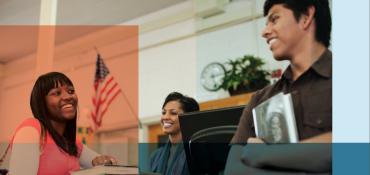
LASHONDA: A top concern for me is trying to get students to understand and care about what’s going on. There’s a lot of days that I look at what’s happening, and I want students to realize that we taught this in global studies or US history. How can we teach so that learning is long term and transfers across the curriculum? Many of our students do not yet have deep enough knowledge to transfer skills from class to class, so how does that affect critical thinking?
I’m also concerned about this because social media and technology are so influential. The best thing that happened in New York was the ban on cellphones in schools.† Children are talking to each other again. We can do group work again. We couldn’t do it as effectively when we had to fight distractions from cellphones because it was hard to get kids to talk. Now, the cafeteria is loud again, which I feel is huge because conversation is such a critical part of seeing others’ humanity, feeling empathy, and learning to put yourself in someone else’s shoes.
For a while, I think our students were desensitized to everything. During the pandemic, the world stopped and everyone had questions, but no one had answers. And we probably had the worst type of leadership. In a lot of ways, technology filled the void, but I think it also stole the soul.
To address this, I often ask my students, “What do you love?” I’m trying to get them to identify their passion, something they care about, because that discussion is not happening, unfortunately, with a lot of our kids.
KARISSA: I agree with that so much. Getting kids to care is one of my biggest concerns. I know how to address misinformation, but apathy is one of the most difficult problems to tackle because it’s so pervasive. And it’s not just our kids. We’re seeing apathetic adults, too—and a lot of it is because we’re so overwhelmed with all that is happening in the world, all the information we’re taking in every day on our phones. At some point, we stop being able to process it all and start to tune out emotionally.
But a few things give me hope. First, the fact that we’re having this conversation. Then the fact that NYSUT is promoting civics and media literacy education initiatives is really encouraging. It makes me feel like we are going to turn things around. NYSUT is tying these initiatives to the 250th anniversary and the idea that the way we get our country back is by having an educated population. Greater literacy, specifically civics literacy, will help sustain democracy. But when people don’t understand how democracy works or how their votes work, and when they don’t know the structures of democracy, they don’t know how to have an impact on it.
There’s a saying, “The best time to plant a tree is 20 years ago; the second-best time is today.” We should have long ago prioritized civics and media literacy starting when students are young; our country might be in a different place right now if we had. But we have to start somewhere, and it has to be a primary goal of our education system. It’s already happening in small pockets around the country, but it has to be deeper and broader.
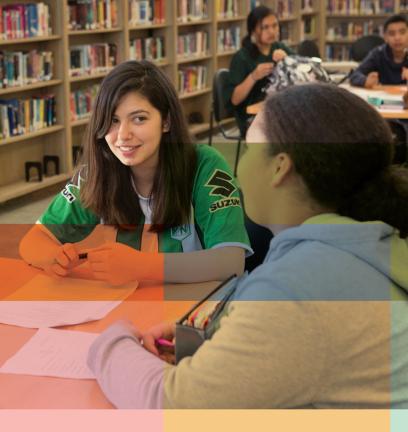
LASHONDA: One thing that has helped emphasize the importance of civic education, at least in some schools, is the New York State Education Department’s Seal of Civic Readiness.2 This program recognizes students who have demonstrated proficiency in civic knowledge and skills. It includes social studies courses and civic projects that students participate in throughout their high school years to earn points toward a Seal of Civic Readiness distinction on their high school diploma. But right now, only about 15 percent of seniors earn it3—not for lack of ability, but for lack of opportunity.
A colleague started the program at our school a few years ago, and my African American history course is one that can be taken as students earn points toward the seal. I’ve seen how the program has helped my special education students find pathways to graduation on a whole new level because aspects of the seal’s requirements are structured like independent studies. My colleague’s course guides them through different projects, and they spend a whole semester studying and researching issues that matter to them, then doing related community-based work. This culminates with a civics readiness day when families come in and the kids present their projects to them and a panel of teachers. Some students have even stayed engaged in their community work after completing the course.
KARISSA: We don’t have the Seal of Civic Readiness at our school, but I know it’s an amazing program and more students should have access to it. When I do summer school in another district, I have eighth-graders who are starting to work on their seal, and they get really involved in thinking about how their community functions, what their role is in it, and how they can create the changes they want to see. I worked with one student who saw that there wasn’t enough access to recreation in the city. She looked first at what existed, and then she researched what could be put in place to give kids free access to parks and recreational programs. These projects are so empowering for the students; they really get interested in their communities, they learn how to use their voices, and they’re given the tools and resources to get more engaged in making change. I love this approach to civic education, so I was really heartened to see that NYSUT gave out 15 grants, totaling $50,000, in the spring to help more schools offer the seal.
EDITORS: How else are you empowering students to engage civically?
LASHONDA: I talk to my kids about my work as a political action coordinator with NYSUT and how unions can help create positive change for our democracy. I encourage students to think about getting involved in a union—and not just as members but as leaders—and I’ve had AFL-CIO and NAACP members come to my class as guest speakers. I teach a lesson on Black Americans in the labor movement and how it connects to civil rights, and I talk about the project I’m working on through Cornell University’s Union Leadership Institute to get more people of color involved in union leadership. I introduce students to different leaders that I’ve met through Cornell so they can see how to position themselves to pull other people up and actually make change. And last year, my kids were invited to attend the AFL-CIO’s Martin Luther King Jr. luncheon, where they met state legislators, and it was another great opportunity for them to see who and what they can be.
I often remind my kids that a lot of the social movements in America were started by young people, and that they have a lot more power than some people want them to believe they have. When I teach the film Selma, we fill out voter registration cards, and I tell them that voting is how they can have a voice in what’s going to happen in their lives.
KARISSA: I love that. As a librarian, my main role is to promote literacy and encourage students to read, but we know books are not necessarily the primary way that most people take in information now. So I feel like my part is through my media literacy class. I focus a lot on news and social media literacy, but media literacy is a very broad umbrella that incorporates all different types of media and how we look at information, including visual media. There are so many ways that information reaches us, so one of the first things I do in my class is teach students how online algorithms work, how our news media works, how to find reliable sources, and how information bubbles make it difficult to understand other people’s perspectives. Each of us is being fed information that confirms and validates our already held beliefs and biases; we don’t get a whole picture of what’s happening in the world—and the way that most of us do our information seeking, it’s nearly impossible to find diverse perspectives on a topic now. So it’s important to ask big questions and think critically to analyze and evaluate the media we consume. Who made this? How did it get in my feed? What does the creator of this media want me to think and why? Once they have those answers, I help students understand the techniques that made a certain media more effective—more likely to reach them and make them want to engage with it.
Being media literate means having the ability to access, analyze, evaluate, create, and act using all forms of media. I feel like in most spaces where media literacy is being taught, we’re ignoring the last two pieces. So, I also ask students what they can do to create media that has that power. How could they use it responsibly to make a difference, to make whatever change they’re hoping to see? That’s one small thing that I do to help empower them.
LASHONDA: That’s not small at all. Your class should be a graduation requirement. In fact, it should be part of the New York state standards for every grade, especially considering the young ages that children are using technology.
KARISSA: I agree. I also think teachers need professional development so that we all know, not just library media specialists, how to teach these skills. Even librarians who’ve been in their role for a long time will need easy access to professional development to prepare to teach these skills.
And I agree that teaching students about collective action is a key way to empower them. I did not come from a union family, so I didn’t really understand the value of a union until I entered this role six years ago. Now I can see how essential organizations designed to protect rights are to our society. We’re living in difficult times. We are seeing federal programs that were built to lift people up being dismantled. Unions are one of the systems that exist to protect our communities and our democracy.
LASHONDA: We teachers have superpowers, if we’re willing to use them. Many families don’t have time to talk to their kids about civic and social issues, and kids are itching to talk to someone and to have their questions answered. So above all, I am constantly trying to speak life into them, push them to find their passion, and show them civics as the lens through which we serve others for the betterment of all. By signing up for elective classes like ours, students show that they already have inside them the seeds to make change and create a better world; we just have to water them.
*For guidance on teaching media literacy skills, see “Learning to Verify” in the Spring 2025 issue of American Educator. (return to article)
†To hear from three union leaders about the impact of this ban, see “Bell to Bell: New York’s Cellphone Ban Is Enriching Classrooms and Allowing Kids to Be Kids” in the Spring 2026 issue of American Educator. (return to article)
Endnotes
1. European Commission, “AI Act,” European Union, digital-strategy.ec.europa.eu/en/policies/regulatory-framework-ai.
2. New York State Education Department, “Seal of Civic Readiness Information,” nysed.gov/standards-instruction/seal-civic-readiness-information.
3. NYSUT, “NYSUT, DemocracyReady NY Call on Legislature to Invest in Civic Readiness,” February 3, 2026, nysut.org/news/2026/february/media-release-civic-readiness.
[Photo credits: Courtesy of LaShonda Bradberry and Karissa O’Reilly; Allison Shelley / The Verbatim Agency for EDUimages; Hill Street Studios / DigitalVision / Getty Images; Allison Shelley / The Verbatim Agency for EDUimages]