 Member Benefits
 How to Join
 En Espanol

“Ladies and gentlemen, distinguished guests, dear friends,” the speaker said. “It’s over.”
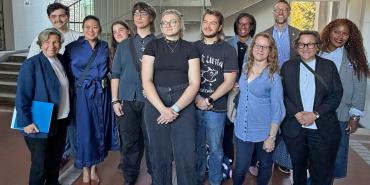
The speaker was Gergely Karácsony, the mayor of Budapest. The occasion was the sixth annual Budapest Forum, held at the Budapest campus of Central European University. In the audience were AFT President Randi Weingarten and four AFT vice presidents, in Hungary on a weeklong solidarity mission at the invitation of the Democratic Trade Union of Teachers, known by its Hungarian initials, PDSZ.
Karácsony was talking about the 16 years of authoritarian rule by Hungary’s prime minister, Viktor Orbán. In April, in an election that drew nearly 80 percent of registered voters, Hungarians ousted Orbán and elected Péter Magyar and his Tisza party.
Back home, during a webinar recapping the trip, moderator Ben Novak, a former Budapest correspondent for the New York Times, admitted he had first thought the visit an “unusual step.” He asked Weingarten directly: “Is it typical for unions to do this sort of thing?”
“It’s typical for us,” she said. “We believe that democracy is absolutely essential if you’re going to have a world order that is about peace and freedom and opportunity. … That requires us to be children of the world, not just children of America.” It also means, she said, workers building relationships with workers, and teachers with teachers, around the world.
Threats to democracy, public education and workers don’t stop at the U.S. border. As one Hungarian teacher told AFT Vice President Jessica Tang, what happens in the United States “is more than just for America. It’s for us too.”
Why Hungary? Why now?
The AFT knows Hungary’s teachers well. In the early 1990s, as communism crumbled, PDSZ leaders turned to the AFT to learn how a democratic union works. This time, the AFT turned to PDSZ for lessons.
Over 16 years, Orbán handed control of most of Hungary’s media to his allies, redrew electoral districts in his party’s favor, took over the nation’s school textbooks and imposed a Christian-national history curriculum. His family and allies grew rich while ordinary Hungarians faced rising prices, political intimidation and disappearing personal freedoms.
The parallels with the Trump administration blare like sirens: attempts to control the media, redistricting, curriculum changes, book bans. And they are no accident. Kevin Roberts, president of the Heritage Foundation, the think tank behind Project 2025, has called Orbán’s Hungary “not just a model for conservative statecraft, but the model.” Vice President JD Vance traveled to Hungary to campaign for Orbán days before the election.
So with the U.S. midterms around the corner, the delegation, which included AFT Vice Presidents Stacy Davis Gates, Jessica Tang, Jeff Freitas and Wendy Coleman, went looking for the answer to two questions: How did Hungarians oust an authoritarian leader, and could Americans do the same?
Four lessons for November
Weingarten came home with four lessons.
- Pre-bunk the fear. Using a portmanteau of “preemptive” and “debunk,” Weingarten described how Magyar’s campaign warned voters in advance that the government would try to frighten them in the final weeks. When the fearmongering came, voters were ready. “They sized down the fear,” Weingarten said, so people could “do the assignment they had, which is to vote.”
- Stay disciplined. Magyar’s campaign kept its focus on corruption and the cost of living. The American version, Weingarten said, is “gas prices, grocery prices, healthcare prices, housing.”
- Go everywhere. Because state-run television wouldn’t give Magyar any airtime, he spent nearly two years driving a small white truck to village squares across Hungary, including places Novak said no politician had ever visited. He talked with everyone, including Orbán voters.
- Turn out the vote. Because so many Hungarians voted, and the margin was so lopsided, Orbán had no room to cry foul. He conceded.
Why labor matters
That turnout struck Davis Gates as a job distinctly cut out for the labor movement. “There is no other entity that I have engaged in American society that can create an 80 percent,” she said. “I’ve only seen that with strike votes … with ratification votes for contracts.” Unions practice democracy every day, she argued, and “that solidarity is actually the thing that gets us to 80 percent.”
Hope vs. Fear
Magyar’s message to voters, Novak said, was simple: Don’t be afraid. Tisza party members showed the delegation ads from both campaigns. Magyar’s were built on hope, Orbán’s on fear.
Coleman found that hope everywhere: in teachers, in students, even in the waiters and waitresses she talked to during dinner. At one high school, a student told her about a gay friend who had been turned away by landlords. Now, the student said, his friend believes he’ll be able to rent an apartment.
“Keeping hope alive for the future is a powerful antidote for despair,” Coleman wrote after returning home.
Weingarten said the same spirit is what turned Hungary’s election. “Something connected this time,” she said. “The improbable became the possible, then the probable. People stared fear in the face, and they went out to vote.”
Read more:
- “What I learned about standing up for our democracy from traveling to Hungary,” AFT Pennsylvania President Wendy G. Coleman
- “They did it in Hungary; we can do it here too.” CFT President Jeff Freitas
- “Lessons from Hungary and History: People Power is How We Prevail,” AFT Massachusetts President Jessica Tang